Pages

Tuesday, 23 December 2014

Faking It

Outraged over Girl Online? Scott Pack doesn't think it's worth exploding over, because it's nothing new. Many famous people don't write their own books, but theirs are keeping bookstores afloat.

"Because the truth is the other books, the 'worthwhile' ones, aren’t popular enough to sustain our industry," he blogged. "And they never will be. The festive boost that the likes of Zoella, Jamie Oliver, underwater dogs and that bloke from Westlife provides is often the difference between a bookshop existing and not existing."

Was it so long ago since everybody was rattled by another ghostwriter's confessions?

Over at Salon, Laura Miller delves into the reason why Zoella's teen fan base feels "betrayed" that she did not write her own book.

From what I understand of Ms Miller's piece, Zoella's fault, if one can call it that, is that she made authenticity part of her brand. People like it if you're "real", especially those who are young, impressionable and bone-tired of faking it - and dealing with fakers - to get through the day.

So I guess her biggest fans should feel cheated - because if plain old Zoe Sugg didn't write her own book, what else did she not do?

A writer (let's call her "Gem") with whom I discussed this feels ghostwriting non-fiction (memoirs, textbooks and the like) is fine; "authors" of such books are often non-writers and have little time to write or research beyond their day jobs. Given the nature of our work, I could commiserate.

Writers of fiction who employ ghostwriters, meanwhile are the real pretenders, said Gem - like artists who don't paint or sculpt their own works. While non-fiction involves stringing together facts into an attractive and engaging narrative, fiction, she feels, is more of creating original material, even if the underlying concepts or ideas originated elsewhere.

Still, James Patterson's books are pretty hot, even though word is that he doesn't really write his own books anymore. But you know, it's like Danish butter cookies. Once someone hits on a winning formula, you can't stop the copycats and you're all, "Screw it, bad mood. WANT."

And for similar reasons, I think we can also give "Katie Price" a pass.

Saturday, 13 December 2014

It Huffed And Puffed And Filled My Sails

For the past several years, worn down by tons of reading I've had to do for work, I couldn't bear to look at another printed page after I clocked out.

And the thought of being in a vast hall full of cheaply priced books failed to excite me.

But this Thursday, as I swept my gaze across rows upon rows of fiction titles at this year's Big Bad Wolf sale, I felt strangely refreshed - and it was just the third table. Well, it was a really long table.

Could it have been the stirrings of a second wind?

At least I made the cashiers happy.

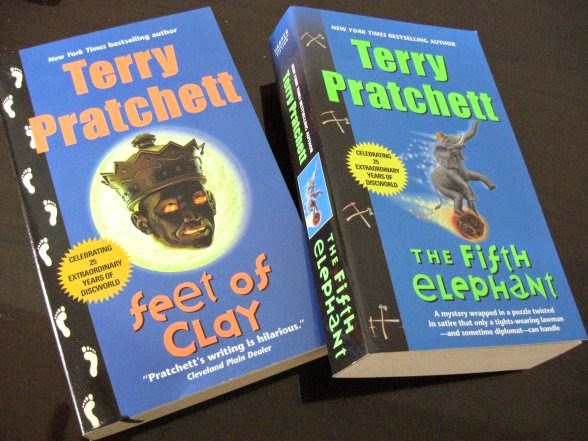
"Oh my, I was shocked," squealed one of the sales assistants at the till as I deposited the two Terry Pratchett titles on the counter and began emptying my backpack. "I thought he only had two books!"


Definitely more than two books; at right is Jamal Mahjoub @ Parker Bilal's
The Golden Scales


A day earlier, a former colleague at the distributors' side became a bona fide colleague again. This time, she occupied her former boss's office. But it also meant that - hooray! - I was getting free books to review, after a months-long drought.

Maybe the second win began blowing earlier than that Thursday morning.

So, yes, I ended up with more than just two books.


First, the Terry Pratchetts. Feet of Clay and The Fifth Elephant are part of the series featuring the Discworld's Watchmen, led by Sam Vimes. I've begun following the series after Guards! Guards!, but too bad they didn't have its immediate sequel, Men at Arms.

Surprisingly, MPH Mid Valley has begun stocking up some of the Pratchett titles in the old Paul Kidby covers, including Men at Arms.

Following the passing of British crime writer PD James, I'd begun searching for her books - like the worst kind of reader. I regretted not picking up the one title I'd found one or two BBW Sales ago.


This year, however, I found two: Cover Her Face, part of the Adam Dalgliesh mysteries; and the more well-known Death Comes to Pemberley. Where should this go in the reading queue?

I was kind of curious about African stories after reading Adaobi Tricia Nwaubani's piece in The New York Times. What have I been missing, I wondered.

So I picked up a few: Taiye Selasi's Ghana Must Go, Nii Ayikwei Parkes's Tail of the Blue Bird and The Spider King' Daughter by Chibundu Onuzo.


I gave The Granta Book of the African Short Story a pass because it was a hardback and the pile was getting too heavy. Guess it was a missed opportunity.

Other books I'd dumped included the English translation of Excursion to Tindari by Italian Andrea Camilleri, two of Alexander McCall Smith's Precious Ramotswe novels: The Kalahari Typing School for Men and The Limpopo Academy of Private Detection, Julian Barnes's The Sense of an Ending, Bring Up The Bodies by Hilary Mantel and Evening is the Whole Day by Preeta Samarasan.

Not just because of weight, but also my pockets.

However, I got two of "those" Malay novels, just to see what the fuss is about. Why are they so popular? Could I figure it out? Are they as awful as some people claim?


Other local buys were The Mouse Deer Kingdom by Chiew-siah Tei (to go with my copy of The Little Hut of Leaping Fishes which remained unread for over a year), the epic novel Amber Road by Boyd Anderson and the Man Asia Award-winning The Garden of Evening Mists by Tan Twan Eng - which I will read before - maybe - a peek at the work of an author who was rumoured to be disgruntled by Tan's Man Asia win.


The odd duck of this pile was Parker Bilal's (real name Jamal Mahjoub, of British-Sudanese descent) The Golden Scales, a crime novel set in Cairo. I flipped through a few pages, assumed (wrongly) this must be one of the works of noir that's getting popular in the Middle East and bagged it.

I went into BBW2014 without a list or a guide, staying away from the best-sellers, literature, romance and, strangely enough, the non-fiction sections. The only non-fiction title I wanted but couldn't find was Blood, Bones and Butter by Gabrielle Hamilton, the chef of Prune in New York. Maybe next year or the following year.

For now, I'll just savour the feeling. It has been a while since I last felt it.

Thursday, 11 December 2014

"Difficult, Downright Thankless"

Turning readers to locally published English-language books "is a difficult, if not downright thankless, job", says The Star, which ran a story about a publishing symposium in Singapore and why things are tough for locally published English books.

Linda Tan Lingard, of the Yusof Gajah Lingard Literary Agency, told The Star: "Locally-published books in English face fierce competition from imported titles."

Oon Yeoh, senior consulting editor at MPH Group Publishing, also put in his two sen:

...local long-form fiction in English doesn't do very well. "Non-fiction books, such as 'how-to' books and cookbooks, tend to do better than fiction, though short story collections sometimes do well."

He added that the price point for locally-published books needs to be lower as well. "Imported titles sell even when they are priced well over RM50, for instance. With local books, however, the buying public is not prepared to spend more than RM50."

So, why are imported foreign English-language titles - some of which do cost more than RM50 - seem more popular among Malaysians than local stuff?

Raman Krishnan of Silverfish Books, who The Star also interviewed, said:

"Anglo/American books are sucking the air out of the Malaysian and Singaporean publishing industries, he said. "In Malaysia, the distributor decides what books the public reads, which in turn is decided by media reports from the West."

He believes the key is in building "a healthy local and regional market". But who's going to put out for that? Will bookstores be willing to invest, when they seem to be more focused on the bottom line than home-grown bylines?


Who really decides?
However, someone from a major books distributor told me it's the reading public who decides what the bookstores sell, based on what's popular with them.

The usual suspects include the Anglo/American stuff, as well as Malay romance, horror, religion and romance-religion (what). And, as my esteemed colleague puts it, the "'how-to' books and cookbooks".

That might be true for the big chains, who depend on shifting as many "hot" items as possible to stay afloat. And if many of their customers are from the middle to upper class, the bit about the Western media's influence in shaping consumption habits sounds plausible - not just for books, but film as well - because, as we know, only that strata of society are more likely to be able to read and have access to that kind of material.

So local writing ends up in what would be considered niches, dismissed as "arty", "fringe", "experimental" - euphemisms for "risky", "unprofitable" and the like in big bookselling.

The Anglo yardstick introduces other problems as well. Nigeria-based author Adaobi Tricia Nwaubani, author of the award-winning I Do Not Come to You by Chance, laid out the problems African authors have in getting noticed (as well as other challenges). In The New York Times, she says African literature is beginning to receive recognition outside the so-called Dark Continent.

The catch?

...we are telling only the stories that foreigners allow us to tell. Publishers in New York and London decide which of us to offer contracts ... American and British judges decide which of us to award accolades ... Apart from South Africa, where some of the Big Five publishers have local branches, the few traditional publishers in Africa tend to prefer buying rights to books that have already sold in the West, instead of risking their meager funds by investing in unknown local talents.

Nope, these African voices, like Nwaubani's, do not come to us by chance.

As a result, she says, most authors in her home country are self-published. But "with no solid infrastructure for marketing and distribution" and the clout that comes with winning international awards:

...the success of these authors' works is often dependent on how many friends, family members and political associates can attend their book launches and pay exorbitant prices for each copy. Or on whether they have a connection in government who can include their book as a recommended text for schools.

Sounds familiar?


Social engineering? Or slow suicide?
I see parallels in the whole "our readers want us to sell these books" with what outgoing ESPN ombudsman Robert Lipsyte seemed to suggest about the sports channel not doing heavy hitting journalism because, according to Slate, "the viewers don't want them to".

"Extensive investigative reporting into the exploitation of college athletes, and the legal battles around that, would seem to conflict with ESPN’s business model," he wrote in his last column. By "business model", I think he means the near-deification of the nation's sports stars.

I'm not sure what kind of myth the big publishers want to foist on the world. That what they publish is all that matters? Can it be as simple as pushing what they deem to be "the thing" while making money out of it?

If that's true, the big publishers' preference and obsession for the next big thing, something The Globe and Mail calls "blockbustering", might spell their doom:

As they grow larger and concentrate their efforts and investments on massive, sure-fire hits ... the cultural landscape seems paradoxically smaller. It becomes even more difficult to get an indie film made – the huge projects suck the oxygen (financing, distribution, media coverage) out of the biosphere (hey, same terminology as Raman's).

In following this larger trend, book publishers are shortsighted. By reducing their involvement in original and challenging art, they relinquish literary fiction to the tiny presses and online magazines, and so become artistically irrelevant and, in the long run, uninteresting even as suppliers of entertainment. Pursuing mainstream popularity with ever-larger sums of money is ultimately self-destructive.

Reversing this trend sounds simple: don't do all that! But will they listen?


Market writers, not what's written
Now, how to start building Raman's local market? "Don't sell books, sell personalities," he told The Star (and everyone else) "Sell the writers."

That would work, considering how kepochi (busybody-ish) Malaysians tend to be. Even if their short-term goal is trying to find out how to be a best-selling author themselves.

Besides, books don't sell themselves. They need to be marketed; the difference is in the degree of marketing. I'm sure even the publisher for Fifty Shades had to tell people "Kinky stuff here!"

Others have had to work real hard. Appearances at book fairs, literary festivals, book tours and signings, media interviews, the whole shebang. The writers who've made it, the names that seem to jump off the shelves, didn't they put in the hours when they first started?

Some of them still tour and perform. Brand names that don't maintain themselves fade away - at least until they start asking "Don't you remember me?"

Examples closer to home include the author of a successful series of autobiographical stories in cartoon format, who has built such a rapport with fans, his books are still selling today; a writer who I heard hawked her crime novel overseas and picked up a deal with a major international publisher; a cycling enthusiast and activist who takes her book about her travels on the road with her; and that best-selling "housewife" who came up with lots of ideas to spread the word about her works.

But again: will bookstores and publishing houses put out, if the authors are up for it - even if they're not famous or established? And, authors: will some of you have the fortitude to swallow your pride and work with the suits to shift the copies?


Reading ahead
An incident about a novel also made me think about the future face of publishing and publishers - as well as marketing and criticism.

The guys with all the passion, they start off small. Once they get big, they are likely to end up swim in bigger oceans where there's LOTS of competition - and spend much of their time just surviving, rather than putting in the hours enlightening the masses and enriching the pool of literature. This eventually sucks them dry of all the love of words and bookselling, leaving them mere shells of the former selves.

Maybe the answer doesn't lie in big but in small, as eloquently put in this piece about the 2014 George Town Literary Festival. Staying small might mean a smaller reach and support base, but it also means more time and effort is spent to fulfil The Purpose, rather than continually fighting for survival.

Monday, 8 December 2014

Third Book! Third Book!

When some people clamoured for a third book at a book-signing session last year, I had little idea it would happen, and quite fast, too.

So yeah, it happened.


And I had to be there at the meet-and-greet session with Cheeming Boey, author of the graphic autobiographical When I Was A Kid series, at the MPH Bookstore in Mid Valley Megamall last Saturday, in conjunction with the release of the third book.

What was surreal was that before Boey walked into the store, Dato' Seri S Samy Vellu entered (I don't think Dato' Seri would've wanted his picture taken).

Besides the poorly designed parking bays and school holiday-season traffic during the weekends, Boey had loads of stuff to say. Unfortunately, I forgot most of it.


Even though he was about half an hour late, people stayed in the store and waited for him. Some were new fans, others were old fans and those who followed his career as an author.

After some anecdotes and a couple of reads from Third Book, well, what's a meet-and-greet without a book-signing session? Especially when the author also draws.

Here, Boey takes a breather to pose for a photo. He is, arguably, photogenic from certain angles.


What inspires his fans' loyalty is that Boey takes the time to chat with them, asks them how they're doing, what they're doing, how's work and all that. Old fans had a chance to catch up with him since the last meet-and-greet, Facebook post or tweet - and he remembers their names. Definitely worth staying on for.

Some of his fans also brought him gifts: a poster, chocolates, biscuits, and so on. I think he also received custom Boey-tattooed cupcakes.


Another loyalty-inspiring bit: custom caricatures! This fan got a birthday present in the form of a Boey-esque cartoon of herself as a fairy princess. Those who bought calendars got their dates of birth personalised, too.


Very few of his autographs these days do not feature a Boey, whether he's in a tux, dressed as a bee, or something. A couple of smartphones also got autographed too - wonder how much they'll fetch at Lelong.my?

Still, nothing so far beats the biggest autograph ever: on an Air Asia Airbus A320.

Then, an interview with journalists from The Star. Strangely enough, Boey was featured in an article by The Star's Elaine Dong in 2010. Back then, he was more known for his intricately drawn Styrofoam coffee cups, some of which go for four figures.


Before things were wrapped up, some of the staff at Mid Valley's MPH Bookstore pose with the author. Guy in the red T-shirt at far right is Joel, also a huge fan.


This is just a small sample of the over-300 photos I took at the event, many of which may not see the light of day. MPH Distributors, who are spreading Boey across Malaysia, Singapore and maybe the world, is getting the whole lot.

These photos of the event and a few more can be found at this Facebook album.

Sunday, 7 December 2014

Masterclass In Session: Audrey's Malaysian Tapas

Tapas, which involves pairing bite-sized morsels of food with (usually alcoholic) drinks, is not merely a Spanish pastime, as seen in the food and travel channels on ASTRO.

From the Greek mezes and Italian antipasti to the English afternoon tea and Hong Kong dim sum, this culinary concept has been bringing people together over food, drink and conversation for ages.


Though Malaysian cuisine features many recipes meant for festive occasions and large banquets, it also has some for small appetites or cosy and more relaxed informal gatherings.

"Malaysian food, with its immense variety and adaptability, lends itself perfectly to tapas-style eating, to be savoured in the most relaxed of settings with minimal cutlery or fuss," says freelance food stylist and food photographer Audrey Lim.


Lim even sees parallels between tapas culture and the Malaysian idea of lepak, and hopes to change how it's perceived. "Some people view this word negatively but to me it's a wonderful concept," she says. "It's about being together, doing absolutely nothing other than enjoying each other's company, fuelled by delicious food and drink."

Inspired, I think, by the local kopitiam culture and third-wave coffee scene, as well as the midnight-oil burning sessions at the mamak stalls, which many might recall.


With Malaysian Tapas, the new volume in the MPH Masterclass Kitchens series, Lim shows how some local favourites lend themselves well to the tapas concept, especially when paired with complementary beverages.


Some thought has been given to how the food and drinks are paired, especially in this part of the world where one strives for balance and harmony in many aspects of life.

Cool off with zesty and refreshing limau ais after some rendang tok canapés. Warm up and relax with some dong quai and rice wine-infused chicken wings and hot ginger tea. Fancy some stingray gulai, with fragrant pandan cooler afterwards?


But it's not all Malaysian-only. Lim also includes her Wild Pepper Leaf Wraps, which hark back to the Thai and Laotian miang kam.

She also clears up a misconception: "The wild pepper leaf (daun kaduk) used to wrap the ingredients is sometimes mistaken as the betel leaf. When chewed on, betel leaves give a mild high similar to that produced by nicotine – not exactly the effect you want the miang kam to have on your guests!"

No, but it would help the guests to chill.

Apparent nods to the Mediterranean origins of tapas include Stir-fried Baby Octopus with Pink Peppercorns (paired with a lemon-honeycomb tea), and Grilled Aubergine with Tomato and Pineapple Salsa (with her kedondong-sour plum drink).

"To me, lepak culture and tapas culture is a match made in culinary heaven, and this book is my little contribution towards making it even more heavenly," says Lim.

So, jom lepak with Audrey Lim's Malaysian tapas!


Malaysian Tapas
Audrey Lim
MPH Group Publishing
185 pages
Non-fiction
ISBN: 978-967-415-261-1

Buy from MPHOnline.com

Friday, 5 December 2014

Book Marks: African Stories, Blockbustering

"My close friend Mercy, when she heard about my novel, congratulated me: I had found out 'what the white people wanted to read and given it to them.'," wrote author Adaobi Tricia Nwaubani in The New York Times. Or, why white people might not be the best judges of what good African stories are.


Are publishers blockbustering themselves into oblivion? Seems that way:

What they are looking for are bestsellers, which tend to be particularly narrow kinds of books. Most of the gargantuan advances that have made headlines in the U.S. recently are for science-fiction and fantasy books. Every publisher is looking for exactly the same book – basically, they are looking for The Hunger Games again and again. When they say "quality," they mean "mass appeal."


How the Strand bookstore keeps going in the age of Amazon.

...the Strand is, when you get down to it, a real-estate business, fronted by a bookstore subsidized by its own below-market lease and the office tenants upstairs. The ground floor of 828 Broadway is worth more as a Trader Joe’s than it is selling Tom Wolfe. When a business continues to exist mostly because its owners like it, the next generation has to like it just as much. Otherwise they’ll cash out.

Yup, simple as that.


Also:

Thursday, 4 December 2014

Masterclass In Session: Rhythmic Gymnastics With Khaw Choon Ean

Rhythmic gymnastics or gimrama, as it is popularly known as in Malaysia, is an activity many parents send their daughters to. Hardly surprising, as it promotes strength, balance, endurance, flexibility, agility, poise and, perhaps most importantly, confidence.

But behind the fancy costumes and mesmerising dance routines is sweat, tears and sometimes blood as rhythmic gymnasts put themselves through countless hours of gruelling training regimes.

Ambitious parents might also be caught off guard by the amount of time, effort and money they have to spend on their daughters' pursuit of that elusive perfect ten.

"Children need their parents' help in finding a good centre and coach," writes Khaw Choon Ean, author of the new guide to rhythmic gymnastics published by MPH Group Publishing.

"Parents have to find the time to accompany the children to their training sessions," she adds. "[They also] have to find the resources to finance the training such as the fees, apparatus and leotards to start them on the sport."

Khaw’s journey in gymnastics parallels the story of rhythmic gymnastics in this country. In her more than four decades in the sport, she has been an official, judge, gymnastics club owner and, in her youth, a gymnast herself.

She is among a select number of pioneers who took something only showcased during National Day parades and grew it into a medal-winning powerhouse in the international sports arena.

Now, comes Kah Choon Ean's Guide to Rhythmic Gymnastics, another contribution of hers to the sport she pretty much grew up with. Arguably, few in Malaysia are qualified to write a book like it.

From a brief history of the sport in Malaysia, Khaw goes on to describe the attributes of the winning gymnast, before guiding readers through the types of apparatus and their use, the training programme, the judging process, dietary requirements, treatment of injuries, cultivating a winning mindset, and more. A list of training venues and gymnastics clubs is also provided, along with contact information.

"After reading this book, the sport of rhythmic gymnastics will likely captivate you but you will go into it with an informed perspective, whether as a parent, gymnast, official or spectator," assures Khaw.


Khaw Choon Ean's Guide to Rhythmic Gymnastics
Khaw Choon Ean
MPH Group Publishing
180 pages
Non-fiction
ISBN: 978-967-415-262-8

Buy from MPHOnline.com

Tuesday, 2 December 2014

Taxing Knowledge

Nurul Izzah Anwar said that knowledge taxation is highly immoral, according to Free Malaysia Today.

The Malaysian MP for Lembah Pantai was referring to the goods and services tax (GST) exemption for certain print books such as school exercise books, dictionaries, textbooks, illustrated children's books and religious texts when the new tax comes into effect next year in April. She felt the tax on books would "discourage a healthy reading culture, and result in knowledge being 'reserved for the wealthy'."

"Knowledge is not a privilege: It is a right," she stated. "The government must classify all books, regardless of category, as a zero-rated item under the GST."

Upon my tweeting this quote, someone asked whether GST will be applied to e-books. Apparently not, if this report is valid.

...the Customs Department made it very clear that e-books will not have GST. This is due to the nature of the product that does not have tangible components and chains of production.

Amir Muhammad also said that e-books were GST-exempt during a panel discussion at the George Town Literary Festival, and exhorted the audience to buy more e-books (including those from his Fixi imprint, one supposes).

While it's good that GST is not imposed on e-books, I have a wee problem with this bit: "does not have tangible components and chains of production".

This might apply for e-books are solely published in digital format, such as direct uploads to Smashwords, but what about digital versions of print books? Don't those originally have tangible components and chains of production?

That being said, I am, for several reasons, concerned about the imposition of GST on printed material. Physical books are already expensive and anything that adds to this cannot possibly be welcomed by consumers.

The shift to GST-exempt e-books might save some pennies, but studies are beginning to suggest that print-free reading might not help the brain absorb and retain information.

When the e-book came about, people were all about the imminent death of print. These days, however, they're saying that the death of books - and print in general - "has been greatly exaggerated".

I'm hoping it stays that way for a long time, come hell, high water, and GST.

Wednesday, 26 November 2014

MPH Quill Issue 43, October to December 2014

In this, the last issue of MPH Quill, the cover and main story feature three authors from the MPH Masterclass Kitchens series: dietitian Goo Chui Hoong, baker Ezekiel Ananthan and cooking instructor Sapna Anand. Get to know them.


Also:

  • Three more personalities: Daphne Iking, Zlwin Chew and Owen Yap shares stuff they can't do without - books, gadgets and ... stuff.
  • Who are the minds behind Malaysian YouTube video channel The Ming Thing and videos such as "Let Me Sleep", "Your Accent Come from Where", "How to Eat Mashed Potatoes" and "How to know You're a Malaysian"?
  • Regular contributors Ellen Whyte and Shantini Suntharajah share time-saving tips and ways to boost your self-esteem, respectively. Also by the former, the lowdown on collective nouns for animals, six herbs to need to get acquainted with, and a quiz to gauge how romantic you are.
  • Three book launches: Made in Malaysia by freelancer and columnist Alexandra Wong, new and reprinted collections by Datuk Lat, and Sofia Leong Abdullah's guide to the franchising industry in Malaysia.
  • A couple of recipes from another Masterclass Kitchen cookbook: The Fat Spoon Cookbook for the upcoming festive season.

And more.

Soon to arrive at all good bookstores, for the last time.

Monday, 24 November 2014

Book Marks: RA Montgomery, Libraries, And Ursula K Le Guin's Speech

An era died a bit more last week with the passing of Glen A Larson, writer of the series my generation grew up with (Knight Rider, The Fall Guy, BJ and the Bear, etc.); and R. A. Montgomery, author and publisher of the "Choose Your Own Adventure" books.

Plus:

  • As part of a conference organised by the Association of Senior Children's and Education Librarians (ASCEL) in the UK, four young readers talked about the power of libraries and librarians. Author and professional speaker Nicola Morgan was impressed with what they had to say.
  • The publisher of (deep breath, please) Malaysia Airlines Flight 370: The Plane, the Passengers—and the True Story of What Happened to the Missing Aircraft says the new book, coming out early next year, "solves mystery of MH370" - except that author says it doesn't. But seems the publisher also screwed up when selecting the cover.
  • When freelance journalist Mridu Khullar Relph spoke to an editor at TIME, he shares some tips on how to pitch one's queries. Also: writer Catalina Rembuyan put together this basic guide on e-book publishing (in Facebook, so you gotta log in, BOO) for Malaysian authors - more than just a primer for those considering digital publishing.
  • Y'all heard about Ursula K Le Guin's speech at National Book Awards? Here it is.
  • Andrew MacGregor Marshall, author of A Kingdom in Crisis, is apparently "delighted" the book is banned by Thai police. In other words: free publicity.
  • How the religious right bought its way into the New York Times best-seller list. Shocked? Don't be. It's not new.
  • New York Times book critic Dwight Garner on reading, reviewing and avoiding blindness.
  • Publishers get kicked out of the Sharjah International Book Fair over copyright violations and other issues.
  • Publishers Pearson and McGraw-Hill pledge to remove climate change denial from their textbooks.
  • Black-market crime fiction and spy novels are becoming popular in North Korea, where titles are available for rent. Considering the level of intrigue in the Hermit Kingdom, this shouldn't surprise anyone. I remember reading about crime and noir fiction being popular in Cairo because audiences kind of relate to what's in them.

Tuesday, 18 November 2014

Book Marks: Pioneer Girl, Bezos's Behemoth, And Lang Leav

Howard Yoon, literary agent and partner at the Ross Yoon Agency in Washington DC, admits that:

There's been a lot of talk about this lately, brought about by the much-publicized dispute between Hachette and Amazon. As a nonfiction literary agent, I wouldn't hesitate to agree that this industry has serious problems, and I think most of my colleagues would agree.

However:

As imperfect as our business is, anyone who wants to write a book of lasting value, a book that can change the way people think about the world, a book that can get national and possibly global distribution in real hard copies, knows that the traditional publishing path is still the best path to take.

Let him tell you why.

Though the Amazon-Hachette spat appears to have ended, it's perhaps a matter of time before the next tussle begins.

Plus:

  • "For generations, the Little House books have stood as the canonical versions of Laura Ingalls Wilder's childhood story," writes Ruth Graham in Slate. Now comes her autobiography, first drafted in 1930 and annotated and published after more than 80 years later.
  • "Anthony Powell's bleak first book is the funniest novel you've never read." This review almost made me run out and get a copy.
  • The poet Lang Leav will be in town on 30 November. Get to know her and her work (a little) before then.
  • Amir Muhammad was at the Sharjah International Book Fair to, among other things, talk about translating works in other languages. We're all familiar with how Amir's ability to ... lighten things up, but Publisher's Weekly could have picked better soundbites.
  • A Q&A with Lydia Millet, author of Mermaids in Paradise.
  • Mexico's "most erotic poet and its most dangerous nun"? A look at a new translation of the works of Sor Juana Inés de la Cruz.
  • "I think this is one of the strongest shortlists in recent years, containing some real literary heavyweights," said Literary Review magazine's Jonathan Beckman about this year's candidates for the Bad Sex Award.

    Among the lucky ones are The Snow Queen by Michael Cunningham, The Narrow Road to the Deep North by Richard Flanagan, Colorless Tsukuru Tazaki and His Years of Pilgrimage by Haruki Murakami, The Age of Magic by Ben Okri and Desert God by Wilbur Smith.

Sunday, 16 November 2014

Sunshine On A Plate

My preoccupation with pasta dishes might have something to do with how versatile I find them. Plus, pastas are becoming a great alternative to rice in my kitchen.

I haven't come up with a name for one pasta dish I cooked up, but I suspect it might already have one: this thing with fresh tomatoes, anchovies (not ikan bilis), garlic and the optional lemon zest and hot sauce.

Let's call it sunshine pasta.

"Sunshine", because it's bright in colour and taste and relatively light. I don't know what I'd call it if you threw in, say, a few lardons of bacon or lamb ragù.

But the lemon zest fits, and I've wanted something with anchovies aka orang putih punya ikan bilis for a quick throw-together when I can't decide where to eat out.

I'd go easy with the hot sauce, though; too much and you'd have a plate of scorching Sahara rather than the tepid tropics.


Mise-en-place for "sunshine pasta"


First, your mise en place (prep): chop or dice a tomato or two, seeds removed. Thinking of keeping the wet jelly-like mess next time. Then, mince two to three cloves of garlic and slice three or four shallots (which you can substitute with a medium-sized red onion).

Pour some hot sauce (maybe two tablespoons) into a bowl and mash an anchovy or two in it, depending on the size. Some anchovies can be as big as small sardines and salty as heck. If that's the case, I won't salt the pasta water.

Boil your pasta as usual. I like mine al dente. Whether it's fusilli, shells or spaghetti, I'd add several extra pieces to test the texture - which is why I don't bother with timing here.

When it yields under your teeth like a stick of chewing gum (without the crunch of the uncooked stuff), take it out of the water. If you're going to throw the pasta back into the pot to cook with the sauce, take it out sooner, maybe a couple of minutes.

You can mix a bit of the pasta water to the hot sauce-anchovy mix but plain water's also fine. Give it a taste; if it's too salty, junk some of the sauce. Otherwise, you can adjust the seasoning later.


Sunshine on a plate, whatever the weather


Plate the pasta and toss it with a bit of olive oil to prevent it from sticking. Some would run the whole lot through cold water to stop the pasta from cooking further (from the residual heat), but I don't. Often, it's not necessary.

Fry up the garlic for several minutes in oil, then throw in the tomatoes, followed by a little water. Let the lot simmer for a few minutes, then start mashing with a fork until you're satisfied with the texture. I usually lift the pot off the heat for this.

Onto the heat for one more stir and in goes the hot sauce-anchovy mix. Give it a quick stir - beware of any fumes from the hot sauce - and toss the pasta in. Stir for a minute or two to let the flavours get in before plating it.

The lemon zest can go in before or after plating, but be sure to toss and stir well before serving.

Sunshine on a plate.