Pages

Showing posts with label Uncategorised. Show all posts

Sunday, 17 May 2026

Chicken Chop Commotion

On social media, a chicken chop café is causing a tiny stir with its list of conditions. Only open for lunch, 11 a.m. to 2 p.m. or until sold out. Only a hundred chops sold each day. Dine-in only, no takeaways, no food delivery. Days open: check social media. Arrangements sbject to change.

The reception has been mixed. Some seem fine with it, while several balked at the rules. What is so special about this shop that warrants all these restrictions? It's like they don't want to do business. So action! They're not even a fine dining place!

I have mixed feelings as well but the main emotion is amusement. In Malaysia, culinary mecca and home of gourmands, one shouldn't be surprised that even a chicken chop shop has its own house rules. I've seen a char koay teow stall with three rules regarding who NOT to sell to, though I suspect it's mostly a marketing gimmick. Could this be the same for the chicken chop shop? Some would think so, but that's probably a tiny part of the story.


Pandemic pressures
I have a small personal connection with this place. A while after it first opened, I was introduced to and then reviewed it for an online news portal. Back then, it sold a bit more than just chicken chop. The owner tried ways and means to bring in more business but results seemed to fall short. There were other woes as well, as the food business is tough.

Then COVID-19 dropped. When the lockdowns started I stopped going around my usual food haunts, so I wasn't sure what happened to the place. Eventually I learnt they were still operating albeit with restrictions, same as many mom-and-pops. While the MCOs are merely a memory by now, they took their toll. Some businesses folded while other soldiered on, weary from the SOPs and changes caused by the economy then and shifting dining habits.

At some point, the café trimmed its menu, trimmed its staff, rebranded itself as That Chicken Chop Shop on Facebook and put all those rules in place. The self-imposed limits sound extreme. What is the point of a café that only sold a hundred of its main dish for a short session each day?


Staying afloat
The whole set-up seems calculated, but not without reason. Keeping a shop open for a whole day exacts its own toll. Foot traffic is unpredictable and the power has to keep going throughout the day. Good days can be few and far between. What happens to unsold stock and how long should they keep it before having to throw it out? What about staff turnover and salaries? These were issues even before the pandemic.

If who walks in can't be managed, then focus on how the café is run. Fixing the number of items sold makes for easier logistics planning, ensures food sold is fresh and there's less need – or no need – to keep unused ingredients.

Other aspects of the business can be scaled down from there. The owner's wife cooks while the owner manages the customers. This focuses the quality control to single points; where food and service are concerned, the buck stops with the owners, so they better be on top of their game.

Everything else: clearing tables, washing and cleaning up, and any task that needs less skill and training can be left to a helper. Even with high staff turnover in the food industry, this cuts down on the headaches that ensue when a worker decides to move on. Training new staff repeatedly is tiresome, especially when the owners are getting on in years. All so they can keep running for just a bit longer.


Customer, not king
For a bunch of self-professed food experts, certain Malaysians seem woefully ignorant of what goes on behind the scenes at the hottest and latest food haunts. Or do their appetites, curiosity and sense of adventure take precedence over everything else?

Years ago at an upmarket dessert café, a Malaysian Karen commented that she didn't feel safe there because it had foreign workers, who she thought brought the place's status to the level of a "wholesale Selayang market". Thank goodness the majority didn't feel that way.

The reason migrants are such an integral part of our F&B scene is because locals are too soft for the demands of the professional kitchen. They can up and quit mid-shift while migrants, with much fewer options, soldier on until they find greener pastures. Migrants didn't "take" those jobs from locals, they simply slid into unfilled niches.

What's funny is that traders at the real Selayang wholesale market told the media they can't get locals to do the work, and those who did "could not cope with the environment and workload, and most did not even last a day while the others left within hours of being hired."

This is not exclusive to us. Too many schools of thought have plenty to say about how to be a good food-and-beverage operator but not how to be a good customer. Contrary to that popular axiom, we are not kings. That goes straight into our heads and breeds expectations we shouldn't have, leading to things that shouldn't be said and done without considering facts, circumstances, and consequences.

I learnt lessons in writing critiques – some of them the hard way. Whether you're deliriously joyful or seething with rage, those emotions blind you to the other side of the story. After some consideration, the thoughts that follow are often not worth expressing, however valid they may feel at the time. Criticising is easy and low-risk – but are you trying to help or do you just want people to know you had a bad day?


Unwritten rules
Even if food places have no house rules, there are rules one should follow when patronising them. Be polite. Long queue? Be patient. Don't be an ass. Malaysians are said to be courteous and we want to maintain that reputation. People raising Cain over The Chicken Chop Shop's rules seem to have forgotten that many places do not allow you to bring outside food to their premises OR use their washrooms if you're not a customer.

With so much on the plate of an F&B operator, having to deal with overbearingly entitled, narcissistic types should be among the least of their priorities. And they shouldn't have to apologise for sticking to SOPs they formulated to keep them sane and afloat.

When it seems so many establishments, not just F&B places, live and die by their reputations these days, an angry review or comment carries more weight than you think. If you're not vibing with the menu, the owner, or the place, go elsewhere. This food mecca of a country has many other spots that are also worth a try.

Monday, 11 May 2026

Changes, Coffee, and Cataracts

Been a long while. Perhaps there isn't much in my life since my last post that merits writing about or I may have outgrown the need to write like I used to. Or do I just don't have the energy any more? Maybe, it's all of the above?

Regardless, I feel like I'm doing myself an injustice if I don't put things down because a fair bit has happened between then and now.


New office, new environment
Early this year I've been moved to another office though my duties and office hours haven't changed. Location, The Exchange TRX. I once dreamed of working at a bookstore and that dream has been realised. I'm not directly involved in bookselling but if there's an opportunity to pitch something, I'm good.

The new posting has me commuting to work via LRT and MRT and the adjustment was a bit difficult for the first week. Sharing space with crowds is draining, and though we're not yet over COVID, another contagion has recently reared its ugly head. Helps that I've continued to mask in public spaces, except when eating or drinking, but I despair at the number who have yet to take the latest potential outbreak seriously.

However, I do miss having certain banking and postal services within reach. And I miss being a regular at a handful of restaurants and drink trucks in the area. The kopi-C at the new place doesn't kick the same. Visitors, under any circumstance avoid whatever passes for kopi-C at the food court. I'm sure the staff are nice hard-working people but the coffee is awful, even if it kicks... albeit in a different way.

Nevertheless, I save enough from not having to drive and park – go, My50 RapidPass! – but all that typically goes to food – still a huge weakness. I typically take my meals at the food court and a favourite destination is the nasi padang kiosk which gives discretionary discounts according to portion size, though not always. The chilli-fried potato wedges with spicy gravy, magnificent. After-lunch dessert is often kuih at any of the kopitiam-style establishments around the area plus iced kopi. Slightly cheaper eats can be had outside the mall but I'm comfortable where I am now.

Any savings have also been offset by too-frequent book-buying. I've been taking advantage of staff discounts (can I mention this?) to pick up any remotely interesting titles, even if I don't plan on reading them immediately. Shortly after my new posting, I had nearly settled my home loan and the exhilaration from that freedom plus the mental shift from lockdown mode drove me book-mad. I've been making up for lost time for about two years but the past few months have been serious. And there may be another factor…


Man at fifty goes for cataract surgery
Towards the end of last year my vision began to blur subtly. Closing one eye after another revealed that one eye had clouded over. But it was several weeks later when I went to my regular ophthalmologist that confirmed that eye had developed cataracts. The guy was startled. Cataracts, at my age? Too soon! While there was no rush, I felt something had to be done.

How's it like to have cataracts? When it's in one eye, the other does the heavy lifting though vision isn't sharp, and I'm nearsighted by default. I could still see but when I announced my intent to drive home for Chinese New Year, I got an earful. My parents and several relatives have been treated for cataracts and they were free with advice on what to do and avoid. Still, I was apprehensive about the surgery and any complications. I eventually went under the knife on a Friday.

Credit goes to the surgeon who's also my ophthalmologist and the anaesthetist though the latter complicated matters a little by insisting that I obtain a letter from an upper respiratory specialist due to my asthma and my request to be put under. While the examination was hitch-free and the letter dispatched, the anaesthetist decided to opt for sedation instead – less trouble and fewer side effects – and it turned out to be a better decision.

The drugs pumped into me may be one reason I can't remember what happened during surgery, which went smoothly – yay for retrograde amnesia. I was sent home with some eye drops, a list of things to note post-surgery, and an appointment to see the ophthalmologist the next day. From that examination, my binocular vision was now 20/20 though not what I would call sharp. Stairs would be a problem and I don't feel I could go back behind the wheel.

The eye, now fitted with a new lens, was no longer clouded. Am I allowed to also thank my company's insurance provider and the eye centre for arranging things behind the scenes and alleviating my anxiety? It helps a ton, considering the state of healthcare in the country.

A bonus from having to get my airway examined was a recommendation to use a sinus rinse, which has done wonders for my nose once I got over the fear of introducing bacteria into my brain through my nostrils. The effects last for days; slightly less after some time in public. Water does get stuck in my screwed-up sinuses for a bit but the pros win out. I won't be doing any rinsing until I get the okay from the ophthalmologist who I'll be seeing again this coming Saturday.

I'm also at risk of developing glaucoma but that's for another day – the ophthalmologist is supposed to be a glaucoma specialist as well, so I should be covered. Maybe this is another reason I've been buying more books than I should, to distract from my ageing and burgeoning eye problems. Maybe that growing stack assures me that I'll have something to go back to after surgery, that things will return to normal.

But you know, I doubt they will.


The fear of going blind crops up now and then since I learnt of my susceptibility to glaucoma, prompting me to wonder if I didn't put enough effort to see all the world has to offer, if I hadn't made the most of my time with sight by gorging on every vista, portrait, every line of prose. However, I'm old enough to recognise that this is not a personal failing as long as you believe you've seen and done enough thus far. Some sights you have the (mis)fortune to see, others are perhaps better left unseen.

For now, I'll strive to make the most of what little time I have left with sight. That to-be-read pile won't read itself. So many new books to explore, so much talent waiting in the wings, so much history yet to unfold. Who could close their eyes on all that?

Wednesday, 14 June 2023

Knowing Myself (Again)

Though things have started changing career-wise, I seem to be stuck in the same existential rut I descended into when I started having sleeping troubles about six years ago. I can't muster the same energy and vibe for work. I've had to rely on dictionaries and thesauruses more. I look at my old work and it looks like someone else wrote it.

Nor do I feel the security and comfort of belonging to a certain tribe. I've ghosted almost all of the connections I made during my forays into writing and publishing while I sorted myself out, and I don't miss the vibe any more. I didn't feel a thing when people recounted their time at a recent literary festival I used to attend.

Divorcing the alienation from the world of letters and the lingering resentment from a failed relationship is hard. Perhaps it's because they're linked. Did I want to write because I wanted to or because I was dragged into it? Instead of a slow, gradual surgical removal, I abruptly ripped out that part of my life in rage. It hurt bad, healed ugly, and evoked phantom pains when I encountered certain triggers. Even now, those pains still lurk beneath the surface.

Whenever these feelings emerge, I remind myself that joy and despair take their turns in life and nothing is constant, so there's no point resenting others for having what I don't have. The things they have come with other things, which I am not yet prepared to shoulder or accommodate. I may not know what I want to be now, but I can distract myself with tiny side projects. Until then, I'll grit my teeth, bear it out and work on those projects, whatever they may be. Seen that way, my world shrinking may not be such a bad thing after all.

An epiphany while watching Accented Cinema's take on why China cared "so much" about Kung Fu Panda slapped me like the thrashing tail of a trout: "Kung Fu Panda loves China more than China loves itself." AC believes that the first KFP film is essentially an American love letter to Chinese culture; though some parts are not culturally accurate, it's an homage so heartfelt that Chinese started asking themselves why they couldn't make something similar.

Perhaps it's that outside-looking-in thing. We seldom recognise our own strengths and unique selling points because we internalise so much of ourselves that it's become second nature, only standing out when seen by others, under certain circumstances. That might be why many creators seek validation from others on social media. Over time, some eventually get addicted to the feedback and adulation – and are devastated when it all comes crashing down.

(Also, China takes itself way too seriously and has too much pride to ever do stuff like KFP, which also pokes fun at itself. They should really lighten up.)

Maybe I stopped writing because I (also) got tired of wondering whether my writing is worth this much or that price. And constantly asking "is it good enough" or "did I get this right" after hitting "Send" can be nerve-wracking. I don't think that will ever change.

I understand better now how self-love requires learning to accept your limits and recognising your strengths, then build upon the latter to mitigate your shortcomings. The process feels arduous because it is. Introspection involves scouring the familiar for the rare, like trying to spot the gem among rows of shops in the neighbourhood you barely glance at usually. Fine-tune your senses and what you'd notice afterwards might surprise you.

Once this becomes natural, you (probably) don't need anyone to boost your morale, but let your inner circle kick you in the butt should you start becoming an asshole. As AC pointed out, China's current animation boom is proof that the nation is learning to love itself Dreamworks-style, so you can, too. "There's no secret ingredient. It's just you."

So I'm starting to write again, and though listicles almost every week with an occasional post in between isn't what some call progress, it's a whole lot better than leaving massive, yawning gaps in the blog publishing schedule. What's important is to "show up", as dictated by the author of the book, Atomic Habits.

And showing up every week has borne fruit. Writing these days is much easier than it was for the past three to four years, even if there was no pandemic. For a long time, I wondered whether anything was worth writing about any more. No longer. So I'm keeping my listicles; reading up for them has helped me find things to write about, and several bullet points eventually became full-fledged posts.

To think, the answer to my writing block was the thing I used to do without too much thought, to keep the blog from stagnating.

Returning to reviews, albeit on a personal level, might take a little longer. But thanks to a few new books, I can start reading without being (too) critical again. It'll be an expensive hobby now that books cost more, and I can't cover the additional costs, but I'd like to think I'm investing in myself.

Man, I'd like things to stay this way for a while longer.

Thursday, 8 June 2023

Kindness At Work

In difficult times, recordings of Ajahn Brahm's talks have been a source of comfort. As he tends to repeat his stories, the trick is to not listen to too many a week, and block off other major distractions while tuning in. He was my drive-home listening for a spell.

One of his tales was about a monk(?) who was "kind" to an automated teller machine, wishing it "good day", and such. Apparently, the ATM "repaid" the kindness by spitting out a twenty-euro bill when the monk passed by.

Of course machines can't reciprocate human gestures. The monk's daily exercises in kindness were more of a reminder to himself to be kind, that even if one's day had been heck, there are things to be grateful for and be kind about.

But stories like this feed into the myth of Buddhism being more than just a philosophy about suffering and the end of suffering, fodder for adherents of the law of attraction and all that.

Nevertheless, I started practising that form of kindness with the car. Nothing special, just a few pats on a headlight when arriving at work or arriving home. On occasion, I do talk to it when nobody's looking, so don't call a shrink on me. I'm already seeing one.

I've been "kind" to the car for a few months and didn't expect anything to happen. But something did, yesterday evening, when I stopped to pump petrol and inflate my tyres. One of them had been repeatedly punctured over a few months and the others weren't looking well either, even though the treads seemed okay.

The problem tyre, located on the driver side up front, sported a cavity that wouldn't look out of place in a bad tooth. Something seemed to have punctured it (again) and a crack had expanded from the entry point.

Going to sleep that night was a little harder than usual. Imagine the catastrophe if that cavity had widened, weakening the tyre till breaking point. I've seen a tyre blow out of a lorry and it was terrifying.

So I have a lot to be grateful for today, even though it kind of sucked: more work poured in, and I already have a near-full plate. For one, the errant tyre, plus its friends, held out until I reached a nearby tyre shop this morning.

"Ye g*ds, how long has it been since you changed your tyres?" the tyre shop foreman exclaimed. "These guys are way past their expiry dates."

So it seems the date of expiry or manufacture was stamped on each tyre, though I couldn't read where. The foreman said something about "2014", so I assumed it was the manufacture date. Going by that, my last tyre change should have been in 2019, yet here I was.

I had been driving up and down highways with potentially explosive tyres for about four years.

I had all the tyres replaced, as the foreman recommended. I went for the cheaper ones they had but if they were substandard the shop wouldn't stock them – not when lives and property are on the line, right? They offered to do the tyre alignment next time, as I was in a bit of a hurry. The bill felt hot and heavy in my wallet but they were nice, so I agreed.

Tyre problems can remain hidden, especially parts that touch the ground where you can't see. What were the chances of that errant tyre showing off that cavity on that day, at that time, when I wanted to pump air into it?

So, yes, for the law-of-attraction crowd and Ajahn Brahm listeners, maybe the car was trying to warn me. PROBLEM. FIX. NOW.

What it's really about is not stressing (too much) about things that have already happened and work on the issue at hand when you can. Worrying about the hole in my tyre wasn't going to help, so I chilled and waited till morning when the tyre shops opened. Be grateful things got fixed.

I've heard many stories from the British-born Buddhist abbot, some of which were told to him, but never have I imagined I'd be living an episode of his tales.

Wednesday, 31 August 2022

Love (Of A Language) Shouldn't Be Forced

The Malaysian Institute of Language and Literature (DBP) has proposed amendments to the DBP Act 1959 to give it more bite in policing usage of the Malay language.

News reports about the matter stated that "Individuals who do not respect the national language can be fined up to RM50,000 or sentenced to imprisonment."

“This is not about grammar or spelling errors, but disrespect for the national language. The proposed fine is not to punish but to evoke love and patriotism to the country,” said the chairman of the Institute's board of governors.

The proposed amendments will reportedly be tabled at the next Parliament session and likely to be passed, but I doubt the aims will be achieved without some collateral damage.

The news reports reveal little about the nature or details of the offences worthy of the ehnanced penaltiess. Even if grammar and spelling errors will not penalised, given the way Malaysian authorities work, one gets an idea of what "offences" might be targeted and who would be most affected: the poor, migrants, older people, and those not sufficiently schooled in BM.

Instead of evoking evoke "love and patriotism to the country", offenders are more likely to end up hating the laws and the Institute. Instead of uniting people, sections of society are pigeonholed based on their proficiency in Malay.

In many ways, how DBP polices language is the same as how the religious authorities police religion in this country, steadfast in the belief that the heavier the mallet, the easier their job. But mangling words or grammar in a language shouldn't be a crime, especially if done unintentionally. As a Finance Minister put it, "why use a sledgehammer to crack a nut?"

More egregious uses of BM can be found on social media. For one, the proliferation of bahasa WeChat needs to be checked.

Language is a living thing, and as in all living things, evolution and growth needs to be organic, and that involves making and learning from mistakes. How will anyone grow if they're made to fear making mistakes?

As much as the authorities like to think harsh punishments will lead to better things, it's not often the case. A conducive learning environment needs to be nurtured, not enforced. Unfortunately, the authorities penchant for the latter seems to suggest they don't have the aptitude for the former.

Love for something needs to be nurtured with knowledge, compassion and forgiveness. Teach and guide people through the basics, be patient with their progress (or initial lack thereof), and be kind when they stumble. Only then will people be more encouraged to learn and participate.

One example is how Indonesian VTubers from the Indonesian branch of the Hololive VTuber agency got their Japanese counterparts to use Indonesian. Never mind that most of what they picked up were swear words, at least they're learning.

A better instance is the collab streams by Hololive Indonesia's Pavolia Reine, where she teaches Indonesian to other Hololivers. Reine's a pretty good tutor, and watching her students pick up choice Indonesian phrases - and throw them back at her - is fun.

Yes, fun. Learning and using languages should be fun. Not an obstacle course at a boot camp for the US Marines. For an example of fun, DBP's official Twitter taps into the pulse of the local daily news cycle by serving up related word or phrase lessons, and poetry - enriching and entertaining.

I felt pangs of grief and a little pride as the Japanese VTubers threw choice phrases at each other and no one in general. Indonesian VTubers are building bridges to Japan, thrilling Indonesian audiences, while DBP fantasises about being a language sheriff.

Relentlessly controlling language - or any form of art, for that matter - will only stifle its growth and lead to fear of its adoption due to such unnecessary pitfalls as fines and jail time for any "disrespect".

And it's not as if the learning will stop with swear words. When the gates and penalties are gone, curiosity will take over and a new world will beckon. What kind of world that would be, depends on those who champion the language.

I think one way to get people curious about language is to tell stories. Well-told stories can be compelling especially if the tales being told share the same culture as the language used to tell it. The writing and production of recent mainland Chinese animated series such as Fairy Album and White Cat Legend got me picking up and rehearsing Chinese off and on. But that's just me.

Malay does have a use beyond urusan kerajaan, beyond an instrument of jingoistic nationalism. We just have to work out what that is.

Wednesday, 4 August 2021

Here Are Some Words

I had more to say in this post, but decided not to, lest I mention something that might be offensive or proven incorrect later. But that's just one of several fears I've borne since I began writing less.

Voltaire was believed to have said, "Perfect is the enemy of good". However, he was apparently quoting some Italian proverb and somewhere down the line it was mistranslated a bit. But its profundity has encouraged some writers to keep writing, internal - and external - editors be damned.

That has become a monumental feat for me because I had a job that demanded a certain degree of perfection in my writing and my current job compels me to demand the same in myself - still! - and in others. Vague briefs and bad writing habits of others complicate matters further. Unfair, but that's how it is.

I had been comfortable with how I wrote for a long time, and in the job where I was first called on to write, my flair and self-possessiveness were shattered. My words were not perfect. All their imperfections were pointed out to me, and in some cases I wasn't allowed to fix them the way I wanted to.

Perhaps it's why I've been subconsciously "counting my scars" now and then, while acquiring new ones.

Someone dragged me into the business of words when they entered my life, but they're gone now, leaving a gaping void I still struggle to fill today.

Words wouldn't fit. Either I haven't written enough of them or it's the compulsion to harshly judge my output. Perhaps due to the nature of their departure, I've come to associate the whole business of writing with this person and have come to loathe it, to be as far away from it as possible.

Regardless, all this led me to distrust my words, and the ever-growing, ever-thickening pandemic fog is not helping.

The lockdowns have kept me away from my old haunts, stripping me of havens where the words can flow a little and depriving me of what little respite I have from my daily troubles.

Some of these factors are beyond my control. What I can do, however, is write. Even on days when I'm not called on to write, when the words don't flow or aren't right, or when I just feel like a pound of fried chicken skin slathered with cheese sauce, a bucket of mashed potatoes and a pile of coleslaw, the mind swarms with words, however chaotic or terrible they sound when put together.

So here I am, and here are some words.

Perfect may be the enemy of good, but I've been told a few times that what I've written is good. My scribbles have been published in newspapers in print and online, so they have to be of a certain standard.

Still, when I pound the keyboard, the desk, and ocassionally the wall in frustration when the words don't fit, all that seems insignificant.

Who the hell am I still trying to please?

What is shattered can never be put back perfectly together - some pieces shall remain missing, however minute. The Japanese practice of kintsugi supposedly illustrates that these gaps can be beautiful when filled with the right things. You probably can't eat out of that bowl again but damn, it looks good and broke the ice with your guests.

So here I am, and here are more words.

My ability to write doesn't have to win a prize or generate social media buzz. It just has to be good enough. Though time and heartache have distorted my Good Enough™ sense, pulling it back into shape shouldn't be too difficult.

Because every time I write, just write, I pound the keyboard, the desk, and ocassionally the wall with less and less frustration as I remember the original shape and feel of my wordsmithing. The journey back is hard but doable because the words still swarm in my head, trying to escape.

Bit by bit, I'll fill that void in me. I can't do a perfect job but hell, I'll do my best to make it interesting.

And instead of asking "Who the hell am I still trying to please?", someday I hope to ask, "Why the hell did it take me so long to figure it out?"

Saturday, 10 July 2021

Sayonara, Chairman

On 1 July, Hololive virtual YouTuber Kiryu Coco graduated, i.e., retired. Fans and her fellow Hololive VTubers mourned. Tributes to her flooded cyberspace. More than 491,000 viewers watched her last "live" appearance on YouTube, perhaps the most ever so far for a Hololive virtual YouTuber in the platform's history.

"All this fuss over a cartoon girl?" Yes, if you've been living under a rock since the pandemic started.


So many VTubers, so little headroom
Virtual YouTubers - or VTubers - aren't a new concept. The idea of an animated avatar stand-in as entertainment goes way back to the days of Max Headroom. With many countries locked down by COVID, more and more sought an escape through online video-streaming platforms.

This was perhaps the time many first encountered a world of online virtual entertainers.

Typically, a real person is behind each virtual avatar, manipulating it through motion tracking technology, like e-wayang kulit. Some movements can be programmed with software, like in videos where the VTuber dances. VTubers also entertain audiences with activities such as playing games, singing, and drawing, and even movie watch-alongs and chats with viewers.

Some virtual talents are independent, while some are part of agencies, with Hololive being the most well-known. Interactions such as collabs among talents within and outside their agencies can and do happen, subject to conditions. Being under an agency helps a great deal in terms of VTuber tech, sponsorships and branding, in lieu of a basic salary.

Income from VTubing generally comes from viewer donations, usually integrated into the streaming service. YouTube, for instance, introduced the superchat, where viewers pay to keep certain comments on screen longer than usual. Some VTubers show their appreciation by reading the names of superchatters after each segment.

Each avatar has its lore or background, which is revealed during their debut and expands over time. Eventually, boundaries between the avatar and the actor blur as their backgrounds meld and incorporates bits of the actor's daily life: family, school, work, and off-screen interactions with other VTubers, and the struggles faced in their VTubing careers.

All this creates a vibrant melting pot of inspiration as artists, musicians, video editors, and the like get in on the lore train with the fans, enriching it. The amount of VTuber-inspired output is growing, and in Japan the avatars are also featured on snacks, drinks, and on special occasions, billboard ads.

Well, this preamble went on longer than it should.

But what I'm saying here that VTubing has sort of bloomed as a form of entertainment, a career, and a PR strategy. You want facts and figures, go somewhere else. However, that brands such as Netflix and even Air Asia is riding the Vtubing surge, debuting their own VTubers as their corporate spokespeople, should be enough to shout that this trend won't be going away soon. Saturated, yes, but not going away. Is anyone aware that Malaysia has its own VTuber agency?

And among the figures driving this boom is a certain orange-haired half-dragon cartoon girl.


A virtual star was born...
Kiryu Coco debuted as a Hololive VTuber around December 2019 along with four other genmates, but she dropped into my YouTube recommendations near the end of the first MCO in Malaysia. She stood out even among her fellow VTubers, not just for her height and cup size. Who was this sassy bilingual lady with a distinctly American Southern drawl who uses "motherf—er" in her catchphrase?

At some point, however, she grew on viewers. With scores of clippers - people who subtitle and post segments of archived VTuber livestreams - that she and her fellow Hololivers spoke mainly Japanese was no barrier to getting to know her.

Coco's voice actress was born and raised American, which explains her accent. She apparently taught herself Japanese after playing a game from Sega's Yakuza series and has been living in Japan for some time after her family moved there for work.

Behind her raunchy, at times foul-mouthed on-screen persona, Coco is smart, forward-thinking, creative, sensitive, compassionate, and pretty selfless. She's helped several Hololivers through personal crises, provided tech support, and mulled the creation of a dorm-cum-office that's more conducive for Hololivers to stream and live in. All this, the lengths she goes to for each stream, and more contributed to her meteoric rise in popularity.

And it shows. Just check out these stats. This website, Playboard, only started tracking these figures early last year, but grossing nearly RM12.3 million in super chats from her debut up to her graduation is no mean feat. Coco's is currently listed as the most superchatted YouTube channel worldwide.

Even assuming that YouTube takes 30 per cent and Hololive, say, 40 per cent, her net earnings are still damn serious for someone who plays an exaggerated version of herself online. Small wonder millions are hopping onto this bandwagon. Well, I thought it was a big deal until I looked up some income tax rates.

Coco is also cited as the main reason Hololive English came about. Its members' popular YouTube channels reached the million-subscriber milestone less than a year after their debuts, and sitting at the top is shark girl Gawr Gura, with more than three million subscribers, beating that of the standard bearer of Japanese VTubing, Kizuna Ai.

She shows more of her caring, introspective side in her "Bar Coco" segments, where she plays the accomodating hostess of a virtual bar helping her guests (the audience) wind down after a long day, dispensing advice and telling jokes. She's done more, but repeating all that here is pointless.

Not for nothing Coco's epithet among fans and colleagues was kaichou or Chairman, a nod to her being a Yakuza fangirl and reflective of her growing influence within the global VTubing sphere.

But there were hard times. Because YouTube is Hololive's primary streaming platform, VTubers who cross the line become demonitised - no superchat or ad revenue - or even banned from streaming temporarily. Coco and several other Hololivers have been hit. And after she broadcasted YouTube stats that showed Taiwan as a country, Chinese nationalist fanatics coordinated a months-long harrassment campaign, spamming her chat window and those of other Hololivers in collaborative streams, to get the company to fire her.

Nevertheless, she persisted, so when she announced in June that she was graduating from Hololive, about one and a half years after her debut and at the peak of her career, everyone was shook. After all she had endured, after all the time and effort she invested, it had come to this?


...but went supernova
The harrassment was one factor, but as the date approached she revealed that she'd found herself descending an unhappy spiral over her streaming activities. Having some of her ideas for streaming and such shot down by management no doubt contributed to her slump. Her fans are understandably furious about the harrassment and the antis are a convenient sandbag. But Hololive appears to be an archetypal Japanese talent agency after all, and Coco's Western ways were never going to be welcome there. She's likely to have haters among Japanese viewers too, for not meeting expectations.

She has already influenced some Hololivers to swear in English and pick up the language to communicate with the wider Anglophone audience, affectionately referred to as "overseas bros". She played a role in getting Hololivers from various branches - Japan, Indonesia and the English-speaking group - to bond. Her presence was inducing changes to the company and probably the industry as a whole, which the conservative segment of Hololive's management probably could not adapt to, in less than two years!

But before management could decide, Coco apparently decided to graduate on her own, announcing the decision first to her colleagues, then to the world maybe several months later, after laying out a roadmap for her exit. Collabs, an original song, a group single with her fellow genmates, and a graduation stream were arranged. She even managed to interview Tanigo Motoaki, a.k.a. YAGOO, the CEO of Cover Corp, Hololive's parent company.

Towards the end, she gave it her all in her last livestreams, often exuding the strongest "whatcha gonna do, fire me?" vibes any outgoing employee has ever displayed.

A bunch of fans including music mixers and artists helped her put together a music video for her cover of "Fansa" ("Fanservice") in time for her graduation - and didn't bill her a yen. Elsewhere, fan tributes poured in: posts, tweets, videos, songs and art. Before and shortly after her exit, during collabs and streams, some Hololivers couldn't hold back tears at the thought of her departure.

Even after her graduation, unlike most idols, her name was not verboten. Coco is still referred to and brought up during livestream conversations by other Hololivers. Several of them even sang her apparently fan-made(!) original song online. Her Twitter account and YouTube channel remain, along with all the other clips of her made by clippers.

It's still cold comfort for fans, especially those who had just discovered her, only to learn that her time with us would be cut short. Many of us who needed an escape from the COVID-riddled reality tumbled into the VTuber rabbit hole, and Coco was among those who first pulled us in. And just when we needed her even more, she left us.


Towards a new sky
I broke down at one point after watching one too many tributes to her online. Tears shed not solely for a star that braved hardship and the ire of petty people only to be unjustly deprived of her chance to shine even brighter, but from everything else that led us to seek solace in her antics and those of other VTubers. The scene just isn't the same without Hololive's naga lucu.

Some have wondered if she would have been more at home with a Western Vtuber agency like, say, VShojo, whose talents tend to be as forward as she is. I don't think so. In VShojo, she would have been just "one of the girls". In Hololive? A more restrained, more wholesome and family-friendly arena? She glowed like a supernova, albeit too brightly and too hot in the end.

It's likely that despite her distinctive voice, as well as her identifying character and verbal tics (which have helped the curious discover her other online identity), Coco insisted on being herself in an alien sky because she knew how bright she'd shine there.

So we can perhaps be comforted by the fact that she'll find another sky to shine in, and that we haven't seen the last of her, assuming she managed to save whatever remained of her love of streaming and cheering up audiences.

Live strong, Chairman, wherever you may be.

Tuesday, 9 February 2021

When The Water's No Longer Fine

Putting pen to paper - or keying things to screen - about the ongoing pandemic and its myriad of inconveniences is hard. Who wants to relive or read about that? No different from daily news reporting for the past year, chock-full of negativity and few bright spots.

Which reminded me of two negative encounters online that I thought I had laid to rest.

One was with a notorious personage who seemed to like nothing more than to brag of their love for literary fiction and the amount of which they've read - and picked fights with others in an online community about their reading choices and apparent lack of knowledge on books.

A few years ago, Personage praised me for something I wrote (forgot which one though) but later, in a comment to my blog that I deleted, harangued me for not knowing anything about Arabic literature, then accusing me of not being literary enough to talk about books. I chalked that up to "Personage being Personage" and brushed it off.

Only when I received news about Personage's terminal illness and passing did much of their behaviour make more sense.

Whether it was their condition or something else, they perhaps found solace for it in the online community and, over time, developed an idealised view of it. When the community failed them in any way, the reality of their situation crept through the crack in the rose-tinted bubble, sparking a backlash.

The quarrels Personage stirred were either attempts to stay inside that fracturing bubble, or cries for help. The people Personage sparred with or hurt might empathise now that the former is gone, but Personage will be known more for the rows and burning bridges.

I have less time and understanding for the guy who tried to interrogate me about a phrase in my Facebook post to a readers' group. I wasn't even talking about Nazis or Hitler, but a chapter in comedian Trevor Noah's book. The bit about Nazis and that there are worse out there was a throwaway remark, but to this guy it was important.

What this dude did, which I now recognise as textbook sealioning, was probably to get me riled up about the Nazi bit because he believes that no, nobody is worse than the Nazis and that I was talking out of my ass when I said that - yet he had no guts to tell me that to my face.

Even then, however, I smelled cari gaduh all over his all-too-polite queries. If Sealion wanted to school me, he could've beat me over the head with his own research and opinions. But assuming that he was genuinely interested in knowing who I thought were worse than Nazis, I don't owe him that either.


People run from trouble. When they can't run any more and they're deep in a rut, they find ways to escape, whether in themselves, safe spaces, or objects. Sweet treats. VTuber clips. Online communities.

But they're not the solution. And you will eventually be disappointed or desensitised.

Personage found comfort in what they believed were like-minded people of a similar calibre, but was quick to judge and condemn when they did not live up to their expectations, seeing gaps in knowledge or understanding as flaws or signs of deception.

So I'm not well acquainted with Arabic literature. That doesn't invalidate whatever else I say about literature in general, or books, writing and editing. It just means I need to brush up on the subject.

For the likes of Personage, however, it's a deal-breaker.

If you're in pain, piling on more hurt on yourself - or lashing out at people - is counterintuitive. But I guess when you're so used to the torment you don't feel the added weight. Nor are you inclined to empathise with others or interrogate your disappointment in them when they "fail" you.

Are they not good enough for you, or have you set the bar too high?

Sometimes, people get caught up in the spirit of things, they forget that these are people too. They have other commitments, issues, and boundaries. That's why administrators of Facebook groups, for instance, lay down rules. Without limits, people will go out of line. I have stepped over boundaries on occasion and the repercussions weren't nice.

No community owes you anything for your participation. Your contributions, however stellar, do not entitle you to more than what the community is willing to offer.

When you're triggered by what someone says, instead of pouncing on a perceived slight, maybe take a step back and ask why you're bothered by it. Was it aimed at you, or a mere shot in the dark that found its mark anyway? As one saying goes, "if you didn't eat those chillies, you won't feel the burn".

Every community has its bad apples. Sussing them out is important, but not as vital as laying out what you expect when you join a community and the lines you - and others - must never cross in your interactions. And don't expect too much from people, no matter how awesome they seem to you.

Eventually, any community will change. The goals may shift, or they may stagnate or turn into cesspits. Maybe the people there have changed, or you have. Maybe the things they share don't interest you any more.

The need to belong is strong in humans. However, one should keep in mind not to sacrifice your individuality and ability to change just to fit in, no matter how much you identify with a certain group.

If you don't feel like you belong, walk away. And leave the bridges alone.

Saturday, 9 January 2021

A Short Squab Story

The chronology of this story I'm about to tell has been jumbled up by the lockdown-induced brain fog. Which did I see first?

The nest behind an air conditioner compressor unit? Or that pigeon parent brooding two chicks?

However, I did belatedly realise that the compressor now sheltering a pigeon nest is one of mine. I discovered the nest last December, and recalled another nest located in the emergency stairwell that had been destroyed weeks before by who I assumed was the cleaning crew.

A nearby fire hose was used, and on the remains of the nest lay two small white eggs. That image still haunts me, and might have kept me from reporting this nest. I'm also a fan of nest cams, so having a real nest nearby to watch would be interesting.

As I followed the chicks' growth, however, my decision to spare the nest and the pigeon family was challenged by how messy and unhygienic it was growing. This was a one-clutch nest, new. But I can't call the cleaners on two defenceless chicks, nor should anyone be forced to do what the may feel is unthinakble.

However, I would need to get the compressor serviced with the air conditioning and this complicated matters. No wonder the cleaning crew resorted to the fire hose.

How long would I have to wait until the chicks fledge?


City shitbird
A little research uncovered more about pigeons than I needed to know, but that's just me being a trivia glutton.

The bird we simply call a "pigeon" - the one with reddish eyes, blue-grey feathers, dark grey tail, and a shiny green and purple neck - is officially known as a rock dove or the common pigeon. So common, it is often considered a pest wherever they are abundant.

You've probably seen flocks of them mooch spilt rice or grain from shops, roosting in trees and on power lines or ledges, "bombing" unsuspecting cars and passers-by, or hanging out in nooks and corners of condo balconies and fouling these areas with feathers and poop.

So that's why I don't have pictures of the nest. You don't want to see any. This creature is also one reason I passed on a unit at a nearby condo. And I have yet to forgive what one of them did to my car 24 hours after I had it polished.

Like dogs, cats, raccoons and the occasional polar bear, pigeons have long associated humans with free food, so I guess we brought that on ourselves.


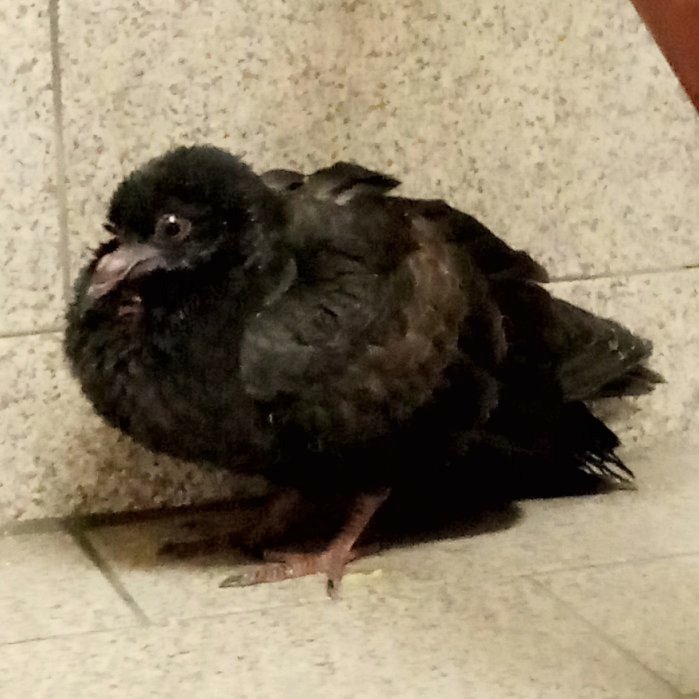
A squab or a juvenile pigeon
Found this squab on the steps of my condo several days after posting.
Not sure if this is the surviving squab SQ1, but it looks about the
same age. Practically a juvenile pigeon by now.


A young pigeon is called a squab - a word I haven't seen in years. When I first read it, I think it referred to some kind of food. Searching for "squab" on Instagram yields many images of dead but well-prepared and beautifully plated birds. Shatin roast pigeon, anyone?

For the first week or so, pigeon squabs are fed an exclusive diet of what's called crop milk or pigeon milk, a nutrient-dense substance that looks like cottage cheese. Both male and female pigeons can produce it, which you'd think would help out a lot when raising young.

But I assume that the amount and quality of crop milk produced depend on how well the bird is doing, so problems crop up if the parents aren't eating enough or, somehow, they have more than two squabs to feed. Pigeoons rarely lay more than two eggs per clutch.

...Thirty days. Squabs take about 30 days to fledge after hatching, which takes 17 to 19 days, but that may depend on how well they were fed. Thought I had forgotten, didn't you?

Also, pigeons breed about once or twice a year. They can have young less than a year after hatching and typically live for a few years in the wild, and longer in captivity. The population will be fine. But be careful when walking or parking your car under trees.


Sibling squab-ble?
My pigeon tenants had two chicks but when I checked on them before last Christmas, I saw that one of the squabs was nearly twice as big as the other.

The smaller and presumably younger one, which I dubbed SQ2, looked at least a week behind its larger sibling, SQ1, in development. The latter had begun sporting juvenile wing and tail feathers while the former was still a grey puffball.

Either SQ2 had hatched late or had a defect that hampered its growth,1 or SQ1 had a farther head start after hatching. Both squabs are aggressive, and after each feeding the parent seemed eager to escape.

Arguably, when feeding your kids involve them shoving their beaks into your throat while you puke your milk, you'd think twice about having them. But we're talking about pigeons, which only seem to exist as fodder and fouler of balconies, ledges, roofs and cars.

So for days I've been hearing the peep peep peep of two pushy squabs from my unit as they wait for Mom or Dad to come home. Then, yesterday - or was it the day before? - I looked out the window and saw SQ1 all but covered in juvenile pigeon plumage.

SQ2, however, was nowhere.


And then there was one
Upon seeing SQ1 and SQ2, I knew the latter would be in trouble. Besides possibly hatching first, SQ1 has been getting the lion's share during feedings. Unable to compete, SQ2 was losing out. Mom and Dad might also be hard-pressed to produce enough crop milk.

The only possibility I can think of is that, when the squabs were chasing Mom or Dad around, jostling for a feed, SQ2 either lost its footing and fell off the ledge, or had been accidentally pushed off by its sibling or parent.

I don't believe it was intentional. Unless they're stressed or barring certain factors,2 pigeons do not turn on their young.

Regardless, I hope SQ2 had died from the fall. Because if it didn't and kept calling for its parents, one of them may kill it in a practice called scalping, in case the squab's cries attract predators.

Nor would falling near another pigeon nest help. Besides being skittish, pigeons are also territorial and will attack or kill squabs other than their own. And if the nest or squabs appear disturbed, the parents will abandon both.

These things happen. The law of the jungle stays even if the jungle itself is gone.


Leaving the nest
Things took another turn today. A hungry squab will chase its parent around until it is sated or the parent flees, but from this afternoon's feeding, the parent seems to be priming SQ1 for take-off. Sometimes I think the adults do this to get their offspring out of the nest ASAP so they can nookie and make more shitbirds.

As SQ1 had migrated from the main ledge to one of the side ledges, I tried to spot it from another window. Looking up and to the left, I was greeted by a tuft of dark grey feathers, then a head with a beak.

A quick visit on my way out to run an errand confirmed the presence of another new pigeon nest one level up, under another air-con compressor. A parent was brooding something on top of what looked like dirtied packing material.

Thus, life finds ways.

When I returned later in the evening, I peered out to the ledge. I was surprised to see SQ1 perched on another ledge two floors down.

The surviving juvenile had, technically, fledged.

Though pigeons are reputed to have good homing instincts, I don't think SQ1 will be returning to the nest, which now requires hazmat treatment. Nasty things lurk in whatever's left behind, including spores of a disease-causing fungus.

And hey, pigeons can carry bird flu viruses too, so please don't trap them for food while in lockdown. We don't want to incubate any more pandemic-grade pathogens.

Nevertheless, I'll be calling the condo management next week to see if they can do something about the empty nest. I wish them - and SQ1, wherever it may be - all the best.


1 From a research paper (PDF file) about reasons squabs die. What atrocious writing. Wasn't this peer-reviewed for grammar?

2 Never knew these cooing crap machines are this savage. These facts and more pigeon trivia can apparently be found on the main site. And with the other supplementary links I've sprinkled throughout, now you and I know more about pigeons than we probably should.

Thursday, 31 December 2020

2020 Sure Sucked, Didn't It?

You can't tell me otherwise.

Thursday, 19 November 2020

Walking Away From Anger

I took mindfulness lessons at a time in my life when I needed more clarity. Problem now is that I tend to notice a bit more in something than I probably should. Things such as a nod to mindfulness and Buddhism in a video game. Specfically, in Street Fighter V.

Talking about this without referencing some history about the game and its in-game lore is hard, so bear with me.

From a straightforward beat-em-up, gaming giant Capcom's Street Fighter franchise went global and is considered iconic. Through sequels, prequels, interquels and crossovers, its lore and growing roster were enriched, evolving into something akin to Marvel's Avengers film franchise. Brilliant marketing to get fans and players more invested in it.

One particular thread concerns the protagonist in all the Street Fighter games: a wandering pugilist named Ryu, a practitioner of a martial art traditionally used by assassins. One aspect of this martial art is access to the satsui no hado, the surge of killing intent. This power promises victory at the cost of one's insanity and even humanity.

After losing to a veteran fighter, young Ryu lashes out with this power, scarring his opponent. Ryu eventually embarks on a journey to hone his fighting skills and find a way to deal with his awakened killing intent before it grows strong enough to erase his humanity.

Decades after the first Street Fighter game, Ryu's struggle with the satsui no hado seems to have reached its denouement with the introduction of a character in an update to SFV: Kage, the manifestation of the dark power within him.

In Kage's mini-story mode, the shadowy being challenges Ryu, who obliges but doesn't want to defeat it. Kage wins, but doesn't understand why Ryu isn't bothered about losing. Chilling on the ground after getting beat, Ryu is all "you wanna kill me, beat me up or just hang around, be my guest."

Unable to get a rise out of his host, Kage fades away.


Anger-eating demon
To some, this might not be significant, unless they've heard of the Buddhist parable of the anger-eating demon. This creature gained power from the fury and hatred others directed at it, and one day it made itself at home in the palace of a king.

Because of the hostility of the king's men towards it, their efforts to kick the demon out failed. Then the ruler returned and killed it with kindness, starving it of its nourishment.

Kage, or the satsui no hado, is a type of anger-eating demon. Unable to interact with the outside world, it requires a sentient host to manipulate and feed on, and its urgings are seldom recognised as such, often disguised as the primal urge to destroy whoever or whatever one deems a problem.

Ryu's struggle with the satsui no hado was probably hard because his goal initially was to force the thing out of him. This took time and energy that might have left him spent and weakened, opening him up to negative thoughts that empowered the darkness.

The king in the Buddhist parable, however, acknowledged the existence of the anger-eating demon invading his palace and disarmed it by treating him like any ordinary person - a guest even - without wasting time or effort getting worked up over its presence.

This, eventually, was how Ryu dealt with Kage.


Leaving the road to ruin
In mindfulness, it is stated that our positives and negatives are part of an indivisible whole; forceful rejection of the parts of us that we don't like hurt because in doing so we damage ourselves.

Instead, we are taught to live with our demons. Mindfulness allows us to look deeper into ourselves to identify those demons, what they feed on, and the triggers that let them take control.

With this knowledge, we can rein in the dark impulses that will make us do things we may regret later, solving the problem before it manifests.

Learn what our demons are, acknowledge their presence and treat them with kindness, but never let them take the wheel. They promise shortcuts and instant gratification, but are more likely to take you on the road to ruin.

Ryu's epiphany in the story mode of SFV puts him on the path his master blazed, a departure from their school's violent past. A path where foes are overwhelmed not by destructive force but incredible compassion towards their inner demons.

A naive outlook in a cynical world, perhaps, but an approach worth pondering. Perhaps the divisions in society can only be healed once we acknowledge the humanity on the other side - and identify the demons controlling them.

The next step will probably be the hardest for many: to walk away from their anger and leave their demons be.

Saturday, 12 September 2020

Sick Weekend

All I did was close my eyes and lean to one side and when I righted myself in my office chair I was struck by a wave of nausea.

I knew what I was in for. This isn't the first time. All those anxiety- and stress-fuelled late nights - some MCO-induced - have finally caught up with me.

Such episodes last quite a bit, but I had little idea how long: all the way to one of my usual clinics. Maybe I've forgotten how bad it gets.

What's more, the doctor was caught in traffic en route to his shift, so it was a long excruciating wait. The young man turned out to be nice and attentive, and he gave me two days' MC. The medicines worked wonders too.

What a nice young man, wheezed my inner ah pek.

However, I risked teetering over the edge this weekend after one or two more late nights, so I'm hurrying this up with my new full-feature keyboard - ASCII code and Word shortcut inputs, yay! - to try and get to bed before midnight.

But OMG, the VOCs emanating from it. Fresh out of the box, what did I expect? Well, I am typing faster than I was with the laptop keys. Feels more natural too.

That my first major Touch 'n Go eWallet transaction outside of toll and parking payments is for my clinic bill says a lot about my life at this point. Yet the company and creditors such as Citibank haven't caught on and sent me more promotions related to healthcare and medicine.

Instead, they feel I haven't been spending enough and nudge me towards things I'm not interested in. No, I don't visit Tealive THAT much. No, 20 per cent off spa day here is still ludicrously expensive. Thankfully, Citibank has stopped e-mailing me about Condotti luggage bags.

But more stressors keep coming. Last night I had to deal with an uninvited guest (first part of its name is synonymous with "rooster") when it was already damn late, and stress levels forced me to sleep in the living room. Might have to do that again tonight.

Now, if only all that water I chased down my supper of savoury oats with would process itself quickly and leave me alone.

Tuesday, 11 August 2020

Rice Rage

A while back, someone tweeted their displeasure at a video of a guy reacting to someone cooking "egg fried rice" on BBC Food, using a version of the archetypal Chinese uncle's accent reminiscent of Stephen Yan's.

They were irked at the notion of making comedy out of exaggerated accents, which they say debases people who speak that way, and panned such acts as entertainment for snobs.

Did "Uncle Roger", a.k.a. London-based Malaysian comedian Nigel Ng, assume this guise to poke fun at the stereotype? Were "snobs" supposed to laugh at him every time he went "Haiya!" or "recalled" some anecdote out of a clichéd Chinese childhood?

Probably not, but the clip Ng's persona reacted to made waves among Asian communities for how rice was cooked in it.

Too much water.
 
Probably not cooked enough.

Draining what looked like partly cooked rice in a colander and rinsing it with running cold water. 
 
Outrage coursed through the Twittersphere. Then, some pointed out that the chef in the clip was cooking rice the Persian way, leaving many of us chastened for jumping the gun.

However, days afterwards, more reactions to the BBC segment emerged on YouTube, with some replicating the recipe almost step by step. A BBC interview with Nigel and Hersha Patel, who demonstrated the recipe, also surfaced. The latter revealed that the recipe was the BBC's and she was following the station's script. 
 
Or maybe these guys were late to the party. What we can conclude from the later reactions is that you won't get "absolutely delicious" egg fried rice from that recipe; one commentator even said that the BBC dish was not "egg fried rice" but "fried rice with egg".

I'm probably not qualified to ask this but did they look at the part where the recipe says to use "150g/5½oz long grain rice or basmati rice"? What rice did they use?

Of course basmati rice would be cooked that way and of course someone from that part of the world would hanker for fried rice and should be allowed to make it how they like with what they have. Just look at how Jamie Oliver does it - do both recipes look authentic?

I've committed crimes against rice - overseasoning, too much water, etc. - when making single-portion servings of it by steaming during the first MCO, using a tip from Twitter. But I do it because it works and I get to eat every grain instead of scraping some off the bottom of the rice cooker pot.

Who'd be in the mood for egg fried rice or anything else Done Right™ when they have so much else going on?

In that light, someone mocking a foreigner doing rice different with an ah pek's accent is committing a worse crime than merely not being funny.

Many of us gleefully dunked on the clip, assuming it was one of a recent string of incidents where Westerners messed around with "our food", and got burned. A more mindful approach would have saved us the embarrassment and give us enough cred to write posts like this. 
 
With no mention of the type of rice being used and why it's cooked the way it was, the clip alone would have raised more than just eyebrows in East Asian homes.

Plus, the written instructions for the rice on the BBC website do not include the hackle-raising step of rinsing the cooked grains that's so prominent in the clip, which now seems to be location-dependent. Perhaps a response to the backlash, or confirmation that the recipe is tailored for certain audiences.

That doesn't change that fact that saying others can't enjoy making and eating certain dishes from certain cuisines because they didn't cook them right is conceited and racist.

Thursday, 2 July 2020

Nest Cam Musings

Besides books, food and music, I'm also a bit of a history buff and enthusiastic about wildlife. What I haven't revealed here about that last bit here is that I've been following blogs and YouTube channels featuring nesting raptors.

Nest cams, to put it simply.

Around March until July - breeding season in parts of the U.S. - these channels usually buzz with activity, although this depends on the location and species. For eagles:

Breeding season varies by latitude. In Florida, egg laying may begin in November whereas in Alaska, egg laying typically occurs in late April through May. In Minnesota, the breeding season typically runs from late-February to early March in the southern part of the state through April into early May in the north.

Watching these birds nest and raise their young - and following the growth of their chicks - is my idea of a TV series catch-up. Few things are quite like it. Reality shows can't compare.

My introduction to this world was a camera feed of a nest of a pair of red-tailed hawks in Washington Square Park in New York.

Hawk couple Bobby and Violet became internet sensations in 2011 via The New York Times and its web cam when they built their nest outside then-NYU President John Sexton’s office on the 12th floor of the Bobst Library building overlooking the park. Violet sadly died later that year... After that, Bobby had two mates, Rosie, and then Aurora (also known as Sadie).

These cams have their fans and the drama on these nests can be quite gripping. However, the Washington Square Park cam is no more, as is the male hawk Bobby. But New York has other red-tailed hawk nests and birders keep an eye on these sites around breeding season.

As in many closely followed drama series, the death of a character is keenly felt. Red-tailed hawks do feed on rodents, and death by rodenticide is common. Bobby may have met the same fate, although a city has many other hazards.

From egg to grave, a raptor's life in the wild is tough. Baby peregrine falcons have died from complications brought on by swarms of black flies, or preyed upon by other raptors such as great horned owls. Birds such as ravens steal unhatched eggs, at times breaking them in the nest itself.

Early this year, a bald eagle chick from a nest in southwestern Florida apparently succumbed to rodenticide after it bled profusely from a broken pin feather, another potentially fatal condition. (Weeks later, this nest saw the birth of two more chicks that fledged successfully.) Pesticides and other forms of pollution affect adults, resulting in fragile eggs that break after being laid or non-viable eggs that don't hatch.

As in drama series, some viewers become too invested in the lives of these raptors. Following the death of a golden eagle chick by starvation on a nest in Latvia, angry comments flooded the chat window of the live YouTube feed.

"If they can instal a camera there, why can't they rescue the chick?"

"What's the point of the camera if it won't help save these birds?"

Anger born of grief, dismay and, perhaps, ignorance.

As environmental scientist Carie Battistone told TV station KCET, "We often do not intervene when bad things happen. In most cases, we choose to let nature take its course, even if it is difficult to see. This is a hard concept to grasp for people watching live video feed as it is normal for humans to be disturbed and emotional about what they see."

The point of the cameras is to show people how these birds nest and raise young. The antics of the chicks (baby hawks = eyasses, baby eagles = eaglets) are fun to watch, especially when they're in their fluffball stage. You can't imagine these chirping puffs of down growing up to become killers. But they have to, so that they can play their role in their ecosystem. They can only do that when they're raised by their parents.

Some behaviours are hardwired, but others are learnt by watching, like what to eat and how to pin down avian prey and pulling the feathers out before self-feeding. And, possibly, the realisation that they can fly.

When a chick hatches, it imprints itself on the first creature it sees. And if it is cared for, it will learn to trust its caregiver, whatever the latter may be. Human helpers can feed a chick and keep it alive until adulthood but they can't teach it everything it needs to survive as an adult.

And because of imprinting, wildlife raised by people from infancy will have a hard time in the wild. It can't function as it should in its own habitat. What if it becomes dependent on humans and actively seeks them out, risking death by trusting the wrong humans?

It's not just people. An odd case of a baby red-tailed hawk that was adopted by a family of bald eagles briefly became a sensation. Both species are rivals in the wild. The chick might have been intended as food but the eagle parents ended up raising it instead. Observers expressed worry that this fledgling hawk's familiarity with eagles might get it killed by one.

Life in the wild is harsh for raptors but members of their own species won't give them as much trouble as humans. They must learn to navigate their habitats to survive and thrive. Despite our good intentions, we can only do so much. Without a thorough understanding of how an ecosystem works, human meddling will only worsen things.

Watching a chick die can be traumatic and we do feel for the parents. However, be aware not to anthropomorphise these unwitting reality stars. They are wild animals and they get over such losses quickly.

Those yelling at "inhumane" or "uncaring" human cam installers probably won't be ready for the spectacle of a parent killing and eating its chicks, or older eaglets bullying their younger siblings to death when competing for food, sometimes killing them outright.

C'est la vie, man.

Unless their objective is research and tracking, many of those who put these cams are careful to minimise contact with these birds to allow them to live as naturally as possible. Their aim is more to educate than entertain.

If we are concerned about the welfare of these magnificent raptors who start out fluffy and cute, why not start with things we can control? For one, don't litter, and cut those damn plastic rings.

Limit or eliminate the use of pesticides. Keep their habitat pristine so that they and their prey can flourish. Don't chop down the trees where they might nest and certainly don't freaking steal their eggs or chicks.

And if you can't do any or all of these, petition those who can. Considering what we've done to the planet, it's the least we can do.

Monday, 30 March 2020

Notes From Confinement

The highway below is quiet - well, as quiet as highways can be. When I first moved in, the highway my apartment overlooks is constantly awake. It hums, roars, groans, buzzes and snarls around the clock. Not one waking hour goes by without some bellyaching from the miles-long, unsleeping tar-clad serpent below.

So it's a little strange to hear it so calm, especially at night. It's almost like it's taking a nap - or lying at home sick, like many parts of the world right now.

Almost two weeks have passed since the Malaysian government passed a movement control order (MCO), one of many steps to stem the spread of COVID-19, a new and potentially lethal illness currently zipping across the globe. People are encouraged to stay indoors except when buying daily essentials and seeking medical aid, and those found flouting the order would be detained and perhaps fined.

Those who came in close contact with the several contagious clusters or known COVID-positive individuals or suspect they might be infected are advised to get themselves checked at the hospital. Fines and possible jail time await those who aren't forthcoming with their health and travel status.

When the MCO was announced various arms of the company discussed how to work from home and what jobs to schedule. I think some of us expected the partial lockdown to go beyond two weeks.

Working from home is no dream to have when you're getting by, plus a mortgage. Without the convenience of restaurant kitchens, you have to carve out time for laundry, housecleaning, grocery shopping, remote bill paying (or ATM visits) and other errands while editing, fact-checking, and deciding whether something needs to be capitalised or italicised.

And not forgetting, making your own meals. Even taking a break from work to make and eat your Indomie can throw off your momentum. Once your stomach is full you don't feel going back to the laptop. Especially when it's a little underpowered for Microsoft Word 2016, when the file takes a minute and a half to save, and Word crashes - when it doesn't make the screen temporarily go black - while repaginating the document or saving the AutoRecovery file.

And if I didn't tell you I took two 15-minute breaks from writing this you wouldn't know. Home has too many distractions for those not inclined to WFH or freelance.

So, no, I'm not coping too well with this working from home thing, even though it's proceeding okay so far. I'm doing even worse with restrictions on movements and the lack of open restaurants and food stalls.

However, my shiny ceramic cooktop has seen more work in these two weeks than it has in a month, boiling milk for masala chai or turmeric milk, and boiling drinking water, and keeping it shiny and clean is tough. I've knocked out several meals in lieu of instant noodles. Still, it's distracting - and discouraging - when the smells of the neighbours' cooking drift through the kitchen window.

Even the old rice pot has been brought out and I'm finally dipping into the tiny bag of rice that laid idle in the fridge since I moved in. I'd only used a little to "sweep away" bad vibes from the empty apartment on moving day, nine months later. A seemingly bonkers tip from Twitter about how to cook single portions of rice with a bain-marie (hot water bath) method actually worked.

But breakfast these days is a smoothie of oats and nuts, with either cocoa powder or chopped carrot. Munchie attacks are soothed by plain oats, cookies or Gardenia cream-filled bread rolls. I only got fruit - apples and oranges - from the market last week. Only a few stalls were open and security guards stood ready with with laser thermometers and hand sanitiser.

I miss eating out. I miss going to a supermarket on a whim and browsing aisles upon aisles of produce for stuff that might be a purple carrot soup, a not-very-good butter chicken, a basil pesto pasta, or a tray of shortbread.

I also miss the convenience of going to the pharmacy for my meds. Folks at home are concerned about my well-being; I have asthma and allergic rhinitis, so catching this bug is a huge no-no. Eating regularly has also been a challenge and my bad gut isn't helping. The latest gastric attack was horrendous.

We take too many things and too many people for granted. Cleaners, cooks, security guards, healthcare professionals, law enforcement, teachers, hired help, public transport, deliverymen, welfare workers ... I think it's starting to sink in just how crucial these functions are, and how tightly knit all of them are in a city environment. When several of these were disrupted, city life began to unravel.

When this is all over, hopefully these overlooked sectors and its workers will get the recognition and their dues. They are Malaysia and they're holding this country together and keeping it running. If we can't get them a raise and a better safety net, let's at least be kinder to them.


But not to politicians. I won't miss many of them, no matter how many bags of rice they send out with their faces on them.

In the days before and during this partial lockdown I bet we've begun to notice the difference between those who "serve" and those who "rule". Not me, that's the language being used by certain quarters. "Thank goodness they are back in power." "Thank goodness they no longer rule over us."

Speaks so much about how some of us (are conditioned to) perceive our MPs and ministers.

"Rule"? Since when do elected representatives "rule" over us? And why do we let them? And why do some people think of "ruling" like how some people think of freelancing or working from home?

Over these several weeks I've seen two groups of people: one bunch coasts by with doing just the bare minimum, leveraging on issues to make themselves more well known; while another works their butts off, putting the issues and those affected in the limelight instead.

Who'd you think I'd choose to have my back during a global pandemic, a global recession, or a zombie apocalypse?

Well, we might not survive the latter, but when it's go-time, I'll be glad that my elected rep will shoot the zombies rather than negotiate with them - or convince them to switch sides.

Wednesday, 18 March 2020

Another Kind Of China Syndrome

I'm not sure where and when concerns over COVID-19 were first raised but if it was in China, the authorities there screwed up imperial. The Middle Kingdom has always been preoccupied with its image in the eyes of the world, often to OCD levels. Remember the 2008 Olympics? The Belt and Road thingy? The Uighur "re-education" camps?

What I've read says news about the disease first surfaced last December, but now it seems that it might have emerged as early as last November. One should note that the first sightings of COVID-19 in China can mean that doctors in China spotted it first, not that this illness came from China.

But when doctors in China first raised alarms about it, Chinese authorities blocked the news from leaking out and silenced, vilified and even disappeared whistleblowers. Because every time a China-related crisis comes up, the first thing its officials seem to think about is "How do we make it look like it's not our fault?"

This might have been what Beijing spent precious weeks on, instead of warning the public and the world at large. And China being China, it's leery of sharing information with other nations, even if it does help. "Suppose they find something they can use against us in the data?"

For me, it's too late for China to rewrite the narrative. No matter how many remedial measures it takes now - which it should've taken much earlier, like, way before Chinese New Year - its role in the virus's spread and its handling of the pandemic locally must not be overlooked. Locking down the flow of information and repeating conspiracy theories don't make it look any better.

Had it acted like conscientious global citizen in the face of a growing (now full-blown) pandemic, China might have looked like the model country it sees itself as.

Thursday, 5 September 2019

Traffic Laws Are For Everybody

Lax enforcement and perceived vulnerability have allowed motorcyclists to run red lights and ride between lanes, etc., with impunity sebab miskin, kasi chan-lah, and so on. But when they screw up they affect more than themselves.

Arguably, many motorcyclists are B40 or thereabouts. So in a city ruled by cars (read: rich people), riding a bike through red lights, traffic jams and road dividers is a way to beat the system.

So it's no surprise some of them are upset when people suggest they obey traffic laws to the letter.

While the risk of being a motorcyclist on Malaysian roads is much higher, assuming that all motorists deliberately make life hell for bikers is almost as gross as the liberties bikers take because of protections afforded to them.

When their asshole behaviours - like kicking cars that don't give way to them - are called out, they challenge you to throw down at the nearest police station, or make it about race or class. How is this anything but ketuanan rempit?

Traffic laws tend to side with motorcyclists because chances of them dying or being disabled are high. And so many riders rack up so, so many citations on the road, they're likely to be let off - not worth the paperwork, perhaps?

But such laissez-faire enforcement and an environment where motorists end up paying for the mistakes of a gung-ho rider would seed a sense of entitlement and untouchability, which there is already too much of elsewhere.

No doubt Malaysians are awful road users. While I've seen some good sorts who give way to other motorists and allow bikes, ambulances and police cars a wide berth, it still fells like they're the exception, not the rule.

Not all car drivers are rich. Nor can they deal with the distress caused by a reckless biker. Scratched or dented side doors? "Kasi chan-lah!" Or "Mai settle kat balai!" Hit a bike that ran a red light? Dead or alive, your fault. That's fair?

Who has time for an earful about road safety and etiquette, the good fortune of the haves and the struggles of the have-nots, and the dangers of the ego from a motorcyclist who ran a red light and nearly collided into your car?

Traffic laws are for everybody. You can't pick and choose which to obey or break at your convenience, especially in situations where lives are at risk. You might be inconvenienced on occasion for toeing the line, but you'll live.

I'm still a fan of equal penalties for everybody, which I think is an effective short-term solution while we get our act together. Malaysians, among many other things, become more careful when money's involved.

True,the roads here are dangerous for motorcyclists. But motorcyclists can be awful too. However, we can all agree that nobody wants accidents. So can drivers and riders meet halfway on this to make our roads safer?

Sunday, 25 August 2019

Bane Of The Broken Ballot

Parts of Twitterjaya erupted when the nascent #UndiRosak movement emerged to crow about the failures of the new government, calling it a vindication of their stand that neither BN nor PH can form a viable government and when forced to choose between two evils, pick neither.

They also seem to be anticipating a surge in spoilt votes now that the voting age has been lowered to 18, perhaps to allow more angry youths to partake in this sort of thing.

But how many voters take this crew seriously? And if this movement gains momentum, can we expect at least half the votes in the next general election to be spoilt? What if all the votes are?

For much of modern Malaysia's history, it's been ruled by one party for so long the rot has seeped in, in the form of corruption, lack of transparency in key decisions and spending, and flagrant abuse of power.

An election has become a game of numbers. Any political party, however altruistic, has to contest in this field according to the rules. Those who don't, lose out. And when an increasingly corrupt, paranoid and power-hungry incumbent is willing to use state machinery to hold on to power, what chance does an opposition have to change things?

A six-decade incumbency also means you have groups that have been disenfranchised from their country's development. Some are kept there with occasional crumbs or populist propaganda about how this is all they have and if they vote for anyone else "others" will take even that away. Others are told to "know your place" and "don't ask too much", or "go back to where you came from".

Bent and broken, these groups keep returning the same people to power, convinced that this will be their lot forever, and that any change will only be for the worse. And it'll be business as usual for the long-ruling incumbents.

Such is the democratic arena in Malaysia, where parties play for points and the downtrodden resignedly sigh "Change is for the rich" when told they can change their lives for the better through the ballot.

This is what #UndiRosak ends up perpetuating while waiting for the arrival of the right party to throw their weight behind, in the hope of changing the country for the better. Their idea of "better", that is.

Many have called them dangerously naive, not without reason. They seem to behave as if all Malaysian politicians care about their constituents and that spoilt votes will terrify them into contrition and make them do better. And if nothing changes, perhaps Malaysia should weather a few more election cycles with the old guard until "better" comes along.

Ha ha ha, nope. And nope.

Do they not sound like someone who will only wait for the right gym and right personal trainer to come along before starting a fitness regime?

Like a long-time couch potato, this country isn't as nimble or hale and hearty enough to adapt to global changes. We've left much of the heavy lifting to the elites, who by now is clear that they don't necessarily have its interests at heart.

A rotting structure is already weak and will degenerate faster, despite being under the same degree of stress. And when there are two evils, not voting for the lesser one will hasten the inevitable.

Fixing such a structure is taxing. Some things will have to be replaced. The transition will be long and painful. Yet we have quitters whining about how terrible the new government is and pledging to switch sides on the next general elections.

You mean, putting the old guard back in, warts and all? When they have demonstrated little to no worth as an opposition and are willing to stoop even lower to regain power, stifle dissent and cover up their tracks? You can hear their desperation screaming from recent headlines, like a banshee's portent of doom.

This country cannot afford to wait for "better". Undoing nearly six decades of damage might take twice as long. Many of my generation will probably be dead before the shift engendered on May 9 starts bearing fruit, but this country will still be around to reap the consequences of our choices now.

#UndiRosak ultimately encourages disillusionment and despair, especially among the "change is for the rich" crowd. People are trying to get them to make themselves heard in a meaningful way, so telling them to spoil their votes is like telling them to scream "We're not voting for anybody because they all suck!" into the void.

It accomplishes nothing, and their grievances are neither conveyed nor addressed. Contesting parties in general elections don't care because their die-hard supporters will vote regardless. In that sense, even voters with a destructive ethnoreligious bent understand the significance of their ballots and respect the election process.

If #UndiRosak wants to damage something, they could start - if they haven't already - by campaigning for local elections. Pockets of the disenfranchised throughout the country can be an intimidating force when empowered and gathered, which is probably why some people want them kept apart and under heel. People, to whom these groups are nothing but vote banks.

If they're sincere about fighting tyranny, they should begin by helping these groups gain some degree of autonomy. As long as they're dependent on federal or state authorities for essentials, these minorities will have no choice but to pick the side that lets them live.

What it would be like if the tables are turned isn't hard to imagine. Seeing the decisions made by some politicians of late, it doesn't look like they're in charge. The right thing is easy to do, so why isn't it being done in many cases?

Because much of the power is still in the wrong hands, and efforts to return that power to the right people will be resisted by those #UndiRosak might relish tripping up.

We've only begun to awaken to the potential of change and some have started grumbling about "the good old days". If the undecided and those who still hope to vote for change are persuaded to spoil their votes for the next elections, I can see only one outcome, and that scares all of those who rejoiced at the results of GE14.

Friday, 2 August 2019

Drug Abuse: Time For Another Approach

Critics are railing against the government's plan to decriminalise drug use. Predictably, the loudest and staunchest critics of the move are the more conservative ones. Of course they would. What else to expect from those who want to amputate the limbs of petty thieves as a deterrent?

"You're not punishing drug users any more? Drug use will explode!"

"Now everybody can shoot up!"

"The drug lords will be happy!"

Decriminalising drug use is not a free pass to use drugs. It must come with measures to deter relapses to be effective. If you're a user, the money they'd spend to try you in court and jail you will be used instead to detox your ass and send you back out to society. If you repeat the offence, well, good luck.

People who resort to drugs to cope with crap in their lives need help. Considering the state of local jails, locking them up will either break them or mould them into criminals of a worse stripe. Then there's the stigma of being an ex-convict, and as Malaysian society in general doesn't believe in mercy or second chances, they're going back to their old habits again.

Drugs will f— you up, but people who see them as a better alternative won't know that until it's too late. Penalties for users are almost as harsh as those for traffickers, which means they are reluctant to seek help - or snitch on their pushers.

Users, mules and peddlers are the most visible parts of the drug trade, so they're easier to catch and report on. Rarely do we see kingpins, manufacturers and their enforcers punished. More must be done to move against the latter bunch. They peddle misery and ultimately death. Among the worst are those who pretend to be friends with people and get them hooked on drugs to line their pockets.

Some will ask, "But wouldn't pushers pass themselves off as users when caught and get off the hook?" While some pushers are users, I doubt many are. People deal drugs to get rich quick and being your own best customer is a no-no. I doubt cola manufacturers would allow their kids near a bottle.

And who funds our prisons? Rather than jailing users, why not clean them up and return them to employment? Most, I feel, won't turn to drugs again after a stint at rehab. Every user jailed is out of the workforce and not contributing to society or tax coffers, and money is wasted on unnecessary prosecution and incarceration.

People who want the retention of heavy penalties only want to sleep better at night. I don't think they've ever been involved with or witnessed the effects of the drug trade. Because they don't see it, and with reports of the arrests, trials and executions of traffickers and mules, they think the laws and penalties are working.

"Only fools - and bad people - would get involved with drugs."

"Drug users and traffickers are bad for society. Hang them all."

"Problems? Be positive! Pray! Spend time with family! Why turn to drugs?"

People who bark this sort of thing tend to be unaware - or wilfully oblivious - that they're doing so from a position of privilege. Two major factors driving the drug trade are extreme poverty and crippling psychological problems - which they probably have never faced in their lives, or have the means to overcome.

Society needs to be less crappy and not rely on the government to wage war on drugs. We need to be less punitive and judgemental. While some willingly go into the drug trade, many who resort to it tend to do so out of desperation. Why punish or stigmatise the latter?

Killing or jailing mules and users might disrupt the trade, but there are far more suckers out there, and the suppliers can just go elsewhere. As long as the raw materials and the need for drugs is there, the suppliers will bounce back.

The big-stick approach to the war against drugs has been tried to death and hasn't really proved itself. Why not kill the trade with kindness? Bet that's never been tried in these parts before.

Saving addicts from their habit and keeping ex-addicts from relapsing will go much farther than merely punishing them. Their stories will serve as a deterrent - drugs are no solution to one's problems = and a message of hope for those struggling to overcome their addiction.